


BP candidates tackle issues at forum
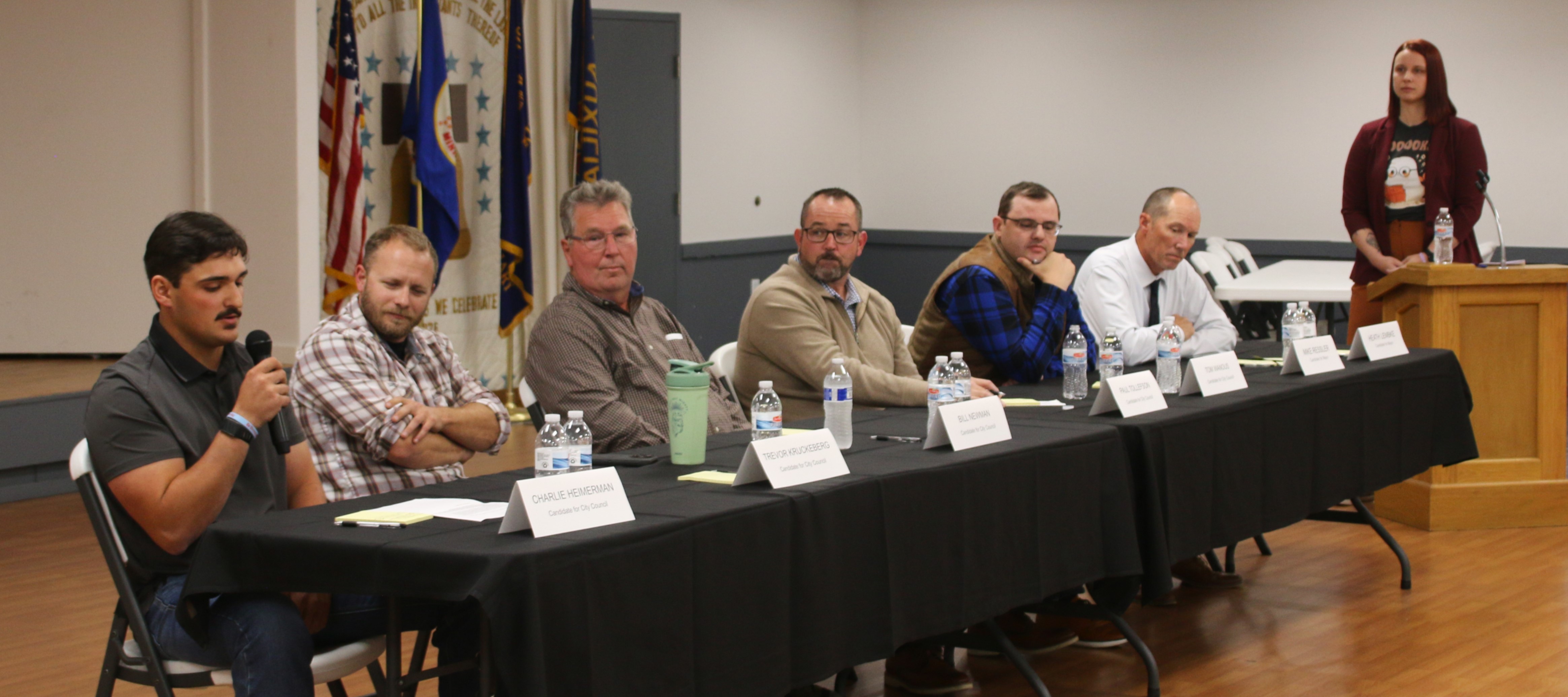
Blooming Prairie City Council candidate Charlie Heimerman, left, answers a question during the BP Area Chamber of Commerce candidate forum last week at the Servicemen’s Club. Listening are the four other council candidates, from second to left, Trevor Kruckeberg, Bill Newman, Paul Tollefson and Tom Wanous. At the end of the table is mayoral candidate Mike Ressler; his challenger Heath Lembke was unable to attend. On the far right is moderator Bethany Anderson. Staff photo by Kay Fate
City street repairs – and how best to pay for them – seemed to be center stage at the first-ever Blooming Prairie City Council Candidate Forum late last week at the Servicemen’s Club.
Five residents are competing for two seats on the council: Charlie Heimerman, Trevor Kruckeberg, Bill Newman, Paul Tollefson and Tom Wanous.
Incumbent Mayor Mike Ressler is facing a challenge from Heath Lembke, who was unable to attend the forum.
The event was moderated by Bethany Anderson, Blooming Prairie Branch librarian.
Candidates were allowed one minute to answer each question.
The questions
What is your highest priority for Blooming Prairie, and what specific action would you take to address it?
Tollefson, a 1997 graduate of BP High School, said “without a doubt, it’s funding, right? And where it comes from… We’ve got some big projects to pay for, and no money to do it. We’re bonded to the max.”
He would approach it with “people that have worked with budgets, that understand this, put a value on what to get rid of and how much to spend.”
Kruckeberg agreed.
“No one wants to pay taxes; I don’t want to pay taxes,” he said, “so I’d try to stay away from that as much as possible by looking at other resources.”
He described a “trickle-down effect, in terms of putting in more houses, then you get more people to move in, build houses and add tax base money to get industrial businesses to come to town.”
Heimerman brought up the infrastructure, with a specific action of “redirecting current funding that Blooming Prairie has, listening to the community and understanding what’s really important to them and then, as a city council, deciding where our funds truly need to be going.”
Wanous believes the council needs to look at “how can we get more starter homes built in Blooming, because we have families that want to move here,” but the current housing inventory doesn’t support that.
“Do we need to expand where they can build? Is there anything we can cut back? Can we allow accessory dwelling units on our lots? There’s a lot of things we can do,” he said, citing nearby Austin’s tax abatements.
“There’s a lot of different incentives that can be done for the city to incentivize those new starter homes,” Wanous said, “and bring in the tax base.”
The incumbents, Ressler and Newman, both named the U.S. Highway 218 reconstruction project through Blooming Prairie. The project dates back to 2022, but has been delayed because of the discovery of soil and groundwater contamination along the corridor.
The city’s plan is to coordinate extensive underground utility replacements, seizing the opportunity to overhaul its aging infrastructure with new sanitary sewer and municipal water mains.
The contamination – and the delay – have nearly tripled the cost of that work, which is now estimated at $4 million. The city received $1 million in assistance from Congressional Budget Spending, but it must have all of the funding secured before the project begins.
What city services or spending areas most need additional investment, and where would you look for savings or additional revenue to maintain a balanced budget?
Every answer contained either “infrastructure,” “streets” or “roads.”
Wanous noted vehicles are much larger and “a lot heavier than they were 20 years ago; roads are getting eaten up a lot more … that’s our reality.” He suggested identifying the worst areas and working “a street at a time” to work it into the capital outlay budget.
Newman corrected Tollefson’s statement that the city is bonded “to the max,” but acknowledged “it’s close.”
The city is paying on five bonding bills now, but one will drop off in 2029 and another in 2030. That may allow for more work on local roads, as well as the wastewater treatment facility “that’s probably 40 years old or greater.”
Tollefson said “roads, of course, and we all know that to help pay for it, increasing our tax base would be lovely, but that takes time.”
There is a need to “look at creative ways our city can save money and bring new funds in in the very short future,” he said, and promised to continue to appeal to state legislators for assistance.
Some residents believe street-repair costs should be shared across the community, rather than assessed primarily to property owners along the affected street, prompting the question:
Would you support reviewing the city’s assessment policy, and what approach do you believe is most equitable?
Recent work on Third Street, Newman said, was more than a million dollars, including improved infrastructure.
“So we’ve been looking at working on some of the streets that don’t have any infrastructure, or minimal infrastructure under them to repair those first,” he said, adding that “it would be OK if a community is paying for more than just one single block or one street or avenue, bearing the burden of the whole thing.”
Heimerman, Wanous and Kruckeberg all support community-shared assessments.
“I drive on more roads in this town than just the one that’s in front of my house,” Kruckeberg said. “Everybody lives in this town; we all should share, because we all use the same roads.”
Heimerman said he considered street projects “an improvement to the entire community, so the entire community should share in (the cost of) that improvement.”
Ressler, Wanous and Tollefson all suggested a hybrid form of cost-sharing, such as work that specifically improves “under their boulevard or that improves their property,” Wanous said.
Tollefson also suggested a “depreciation schedule: If we think that road is going to last for 20 years, then over than 20 years, we need to be putting money into an account” for the future work.
Other answers
All of the candidates supported maintaining local police, fire and ambulance services, one of the 13 questions, with a caveat from Wanous.
It’s nice having the services, he said, but “maybe I’ll be the one to say the thing that nobody’s going to say: We have to keep all of our options open if we want to keep our expenses down.”
Public safety is more than a third of the city’s budget, Wanous said, then suggested options like “partnering with neighboring towns” and not duplicating services that could save money.
Tollefson, too, spoke of “looking for creative ways to make cuts.”
He was the lone opposition to a single garbage-hauling provider, saying options keep prices low.
The other candidates either supported it wholly or were open to the idea.
A question about preventing conflicts of interest and providing easy access to information about city decisions brought out more differences.
“One of the biggest problems that I’ve seen … is not enough transparency,” Tollefson said early in the evening in response to a different question. “Maybe your idea is actually shared by the council – it’s just not communicated very well. I’ve seen that a few times, actually.”
He came back to it when addressing the access to information.
“I think it is a major problem,” he said. “We’re live-streaming this right now, so I don’t see why that couldn’t be done for our … city council meetings, as well.”
Wanous disputed Tollefson’s assessment, saying that while preparing for the forum, he found “there’s a lot of information that is available online already… The more we can get on there, the better.”
Kruckeberg agreed.
“It’s 2026. Everything could just get dumped online,” he said. “I think more people would prefer that, because we all have busy lives.”
People with questions, Kruckeberg said, “can send an email, or (click) a link and send it to whoever you want.”
The meetings used to be recorded for Owatonna Live, something Heimerman noted, before the owner closed that portion of his business.
“I also do agree with Tom … that if you really want to look for it, it’s out there and you can find it” on the website, he said.
Ressler, who is completing his first term as mayor, said he “would love it if more people would come to city council meetings and listen to what’s actually being talked about …
“I think it only benefits the residents themselves to find out what’s going on, and maybe they have an idea of the direction things might be going,” he said.
Newman called it a “real tough (question), because I find it hard to believe that we’re not transparent… Our meetings are the second Monday of the month; they can come any time they want,” call him or come to his house.
“I have no problem with that; you can communicate with us,” he said.