


‘This isn’t about me’
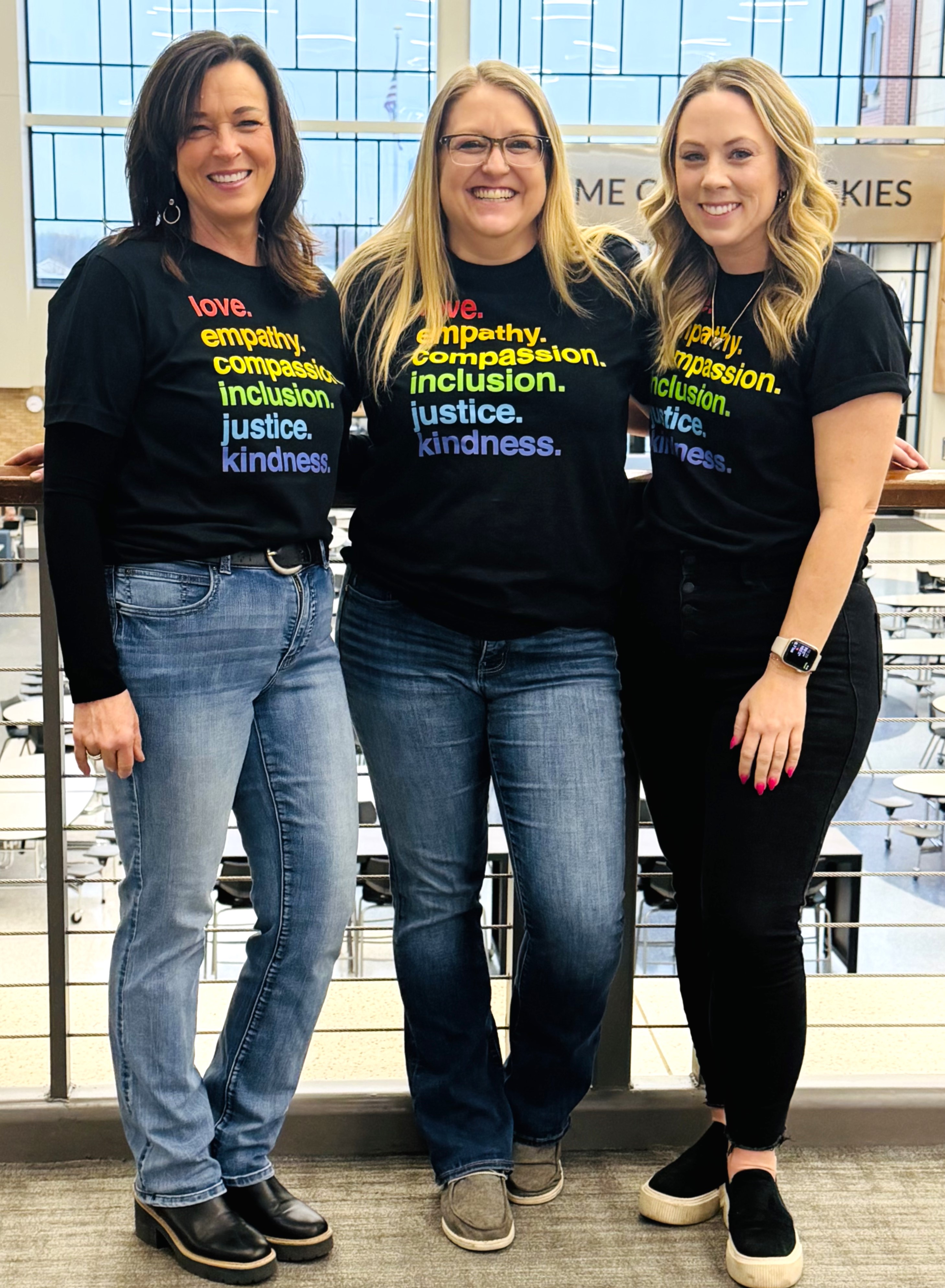
Nancy Williams, left, was named the National School Social Worker of the Year this spring. She is pictured here with her social work team at Owatonna High School, which includes Joli Mancilman, center, and Casie DeVos. Submitted photo
-Nancy Williams, Top National Social Worker
She is as reluctant as she is talented.
Nancy Williams, who has spent more than 30 years as a social worker in the Owatonna Public Schools, tried very hard to downplay her national award.
“Never would I have thought that somehow I would rise above other people, nationwide, but I’ve had really, really great mentors and teams I’ve worked with,” she said. “When you’re in a district that values the whole child – including their mental health – and recognizing that we have to support them emotionally and socially and behaviorally for them to excel academically…
“When you work in a district like that, you’re golden, right?” Williams said.
Or the gold standard, as it turns out.
State, then national
Williams was named the National School Social Worker of the Year, stacked atop last fall’s win at the state level.
Despite the number of years she’s been doing the work, and the number of ideas she’s implemented to help students, “I was more than blindsided,” Williams said. “It was such a huge honor, honestly, to be selected” at the state level – winning the national award wasn’t even on her radar.
“There are amazing people doing the same job that I do all over the state, in all the (school) districts, so that was such a huge honor,” she said.
Williams learned of the big award in February, and was invited to the national conference in St. Louis, Mo., to accept the award – but there was a slight problem.
“As it turned out, we’d already booked our spring break trip, and it was during that time,” she said.
There was talk of changing flights and rearranging their stay, “but we ended up not going, and I did my acceptance speech via video recording.”
Spring breaks are no small thing in a family of teachers; Williams is married to OHS teacher and head football coach Jeff Williams.
Not only did she not go to the conference – she didn’t really tell anyone.
“This isn’t about me,” Williams said. “This should be about the kids.”
Through the years
She was hired by OPS in 1993, when there were just three social workers in the entire district; she was placed in McKinley Elementary.
Thanks to a forward-thinking Steele County Board and Owatonna School Board, there was support for adding more.
There were budget cuts happening, too, “so we were pretty progressive way back then,” Williams said. “Now we have 12 school social workers, if you can imagine.”
The district has put social workers in every building; at the middle and high schools, there are multiple social workers because of the larger populations.
There are social workers for “tiny little children all the way up” to high school, she said.
During periods of budget adjustments, Williams said, “for our department to come out unscathed really speaks to the school board, the superintendent and our administrators saying, ‘this is important. We value … making sure that all of our kids are getting their needs met, and their mental health is just as important as everything else.’”
Additional support
Social workers used to go into the elementary school classrooms and do what was called SEL – Social Emotional Learning. It was used to help kids learn how to “regulate their bodies and their brains and how to resolve conflict peacefully – just ways to manage their emotions,” Williams said.
But after seeing the positive effects of mental health support, as well as connections to the community and resources “and all of the things that social workers come to with their expertise,” the district has added school counselors to all of the buildings.
That includes the elementary schools, “when they they’re little sponges,” Williams said.
The school counselors handle “Tier One” interventions, helping every student learn the skill of handling emotions. When kids rise above that need, social workers step in for a higher level of support.
“We’ve got such a nice partnership now,” Williams said, “working in tandem with our school counselors… We put a ton of work into helping kids from the youngest of ages learn how to regulate their body and their emotions and use their words, and be respectful and include everyone – just all of the stuff that we want for people to be good citizens eventually.”
While that success may look different for every student, the empathetic and compassionate approach remain the same.
OHS has three social workers, four school counselors, one REACH counselor and two Career Navigators.
“We’re all working together all the time to just break down barriers for kids, give them access, let them know they can do the hard things – and whatever path they choose to go on, there is access for them,” Williams said.
“We feel so much support from our administration, from our school board, from our superintendent,” she added. “Any decision they make, they think about how it is going to impact the students in our district. We have such a great community that rallies behind us – including teachers, paraprofessionals, lunch ladies, maintenance crew, secretarial staff…”
OHS Principal Kory Kath nominated Williams for the state award.
“Nancy is an incredible asset to our school and community,” he said. “She understands the importance of surrounding students with the necessary supports to ensure success and always finds a way to bring the best possible outcome and make it happen.
“The most important thing Nancy does for our students is believe in them and their ability to live their best life,” Kath said. “She brings leadership to our students at OHS and throughout the community. Her energy and willingness to help is absolutely contagious.”
For her part, Williams feels the same about Kath, saying he recognizes the need “for every single kid to feel seen and heard and valued.
“I talk about the school district, and we’re lucky there,” she said, “but we’re just super grateful and fortunate for the entire community as well.”
Finding balance
Dealing with students who come from trauma – situations of violence or parental addiction, homelessness – and have mental health diagnoses requires intensive work.
Burnout rates are high in all types of health care, so to spend more than three decades doing it speaks not only to the school district, but “the team you work with each and every day,” Williams said. “You’re able to pick each other up and tell each other, ‘it’s OK. We’ll try again tomorrow.’ You can’t do it in a silo; getting a different perspective helps everyone.”
She finds perspective while supporting her husband’s coaching and other activities, attending her two sons’ activities and sports, exercising and being with extended family.
Their oldest son Matthew is now in his first year as an educator, teaching special education at McKinley Elementary – the school where his mother got her start.
He and his brother Nicholas put their mother’s award in language most meaningful to the sports-loving family:
“They said, ‘Mom, you clenched the Natty!’ – you know, the national championship, so we laughed about that,” Williams said.
“I don’t need any awards,” she repeated. “I don’t need any recognition,” though she has loved hearing from people she has helped throughout the years.
“You don’t do this for those moments,” Williams said, “but when something like this is out there, then a lot of people find a way to reach back out to you – and that’s been, by far, the best part of all of it.”