


LIFE, LIBERTY AND PURSUIT OF HAPPINESS
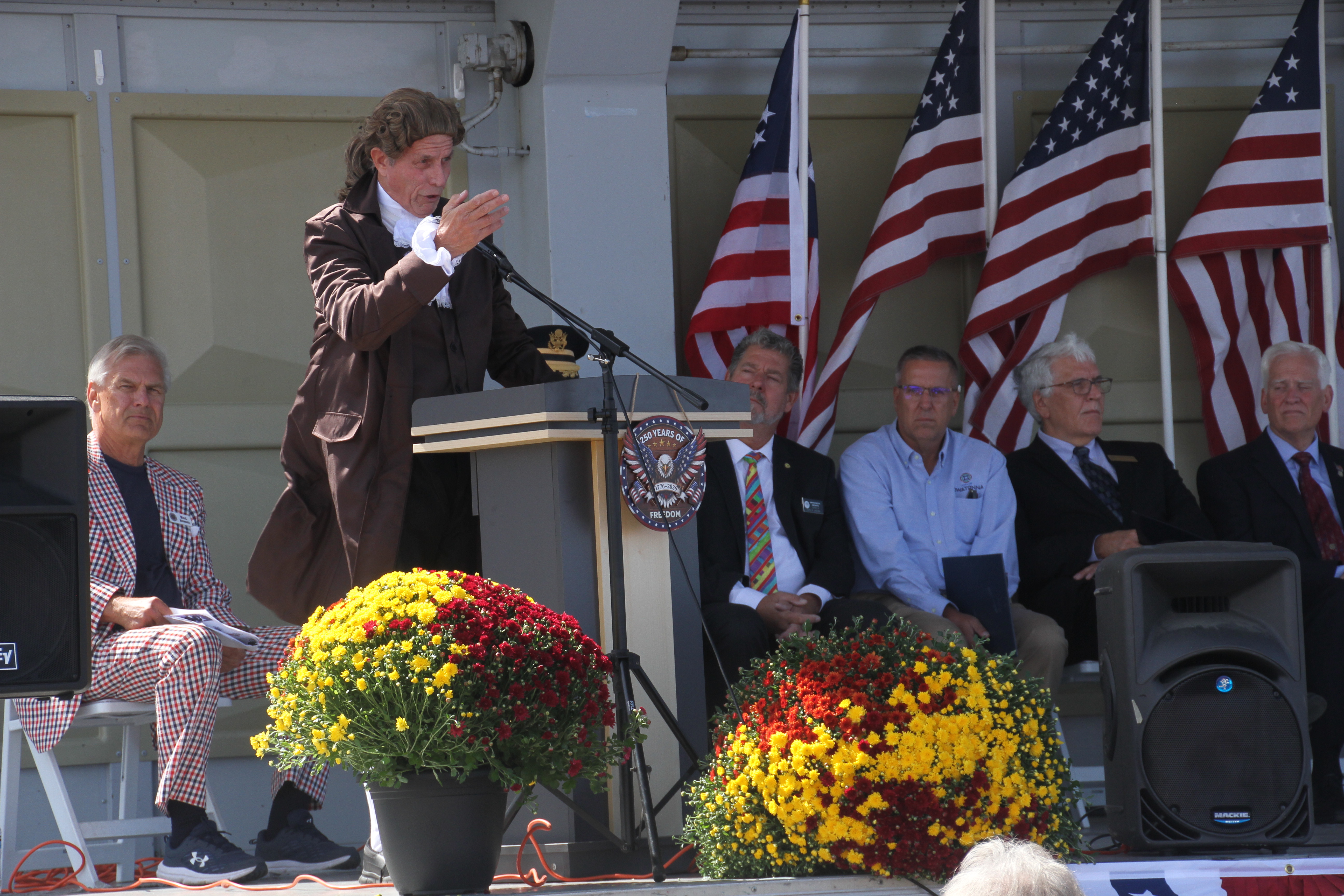
President Thomas Jefferson, interpreted by Robert McComas-Wood of Owatonna, addressed the crowd last Saturday at the dedication of the America 250 Honor Field at the Degner Regional Airport. 1,000 American flags, as well as a number of historical flags, were on display at the airport. Staff photo by Rick Bussler
-President Thomas Jefferson, AKA: Robert McComas-Wood
The United States third president, Thomas Jefferson, (AKA Robert McComas-Wood) stopped in Owatonna Saturday afternoon, to give the keynote note address at the Steele County America 250 Honor Field dedication at Owatonna Degner Regional Airport.
“As I stand here before you today, looking out at these hundreds of flags, my mind cannot help but to wander back across the vast sea of time—250 years to be exact,” he said.
He recalled thinking of another summer, July 1776 in Philadelphia and the contrast, he said, could not be more stark.
At Owatonna, he said, the group was gathered under the open infinite blue sky, surrounded by a peaceful green expanse and breathing the clean air of freedom. In 1776, he went on, they were “cooped up inside the sweltering, airless room of the Pennsylvania State House. The windows, he added were shut tightly to keep out the swarms of flies from the nearby horse stables.
They had no banners, he said, or national symbols, no military might to guarantee their survival and no certainty of the future.
The men gathered knew with certainty when they dipped their quill pens into the inkwells to sign their names to the document, they were quite possibly signing their own death warrants.
Looking at that document today, the Declaration of Independence, he said, he realized those treasonous and dangerous ideas have transformed.
The document put on paper “truths to be self-evident” and these truths “belong to every human being on earth by virtue of being born.”
He said he fought fiercely for the specific words “life, liberty and the pursuit of happiness.” The traditional political thinkers of his time argued that government existed to protect life, liberty and property. “I insisted on changing it.”
Pursuit of happiness meant something entirely different, he said. That it is a spiritual right. The United States, he said, was not founded on a shared ancestry, a single religion, a royal bloodline or the belief that any human being was by virtue of wealth, power or position inherently better than their neighbor.”
But, he said, words on a page do automatically create a perfect world. Looking back with the perspective of 250 years he could see the grand sweep of American history and the deep, painful contradictions of his own life and era.
They wrote all men were created equal, yet they lived in a society where millions of human beings were held in the cruel bonds of slavery. He admitted he was tangled in that deeply flawed and morally wrong system, unable to find a way out of a practice he knew to be a moral blight on the country.
“The America of 1776 did not extend its promises to women, to indigenous peoples, or to many who came to this land with hope and labored under the American sky,” he said.
He added it is easy to look back at the founding generation and see only the flaws, and just as easy to look back and see only the heroism.
“The true value of the Declaration of Independence is that it was never meant to be a picture of who Americans were in 1776,” he said. It was a blueprint and a promise made to the future, and it was a promise they knew they could not fulfill in their lifetime. But it was passed down to future generations and is the story of a flawed vessel carrying a perfect idea.
Every generation since has co-signed on the original document from the bloody battlefields of the Civil War to the women who marched demanding the right to vote, by the civil rights leaders who stood on the steps of the Lincoln Memorial and by every family that came to this country with a hope and a dream of freedom and a better life for their children.
Moving to the present, he told the assembled crows that the challenges of today are different from the ones faced in 1776, but they require the exact same courage.
“Today you face the challenges of division, of cynicism and the dangerous belief that our best days are behind us. These doubts and divisions can be as deadly to this democracy as was the king’s hangman rope in 1776.”
Today’s Americans are caretakers of these radical ideas, and it must be protected through free and open debates, civic action and voting, he said, encouraging citizens to look past the modern divisions and remember the core compact that binds them together as one people.
McComas-Wood said before his interpretation of Jefferson that the Owatonna event was the first time he had portrayed Thomas Jefferson. He moved to Owatonna from the Baltimore area and has taught history in both middle and high schools.
Jefferson, he said, was a deep thinker. He was very proper and conducted himself in that manner, McComas-Wood said, and was a very principled individual. He fought to eliminate slavery even though he owned slaves. He understood the contradictions in life. His ideas were radical for his time, McComas-Wood said. “He’s an interesting character.”