


OPU dedicates Warehime Community Room
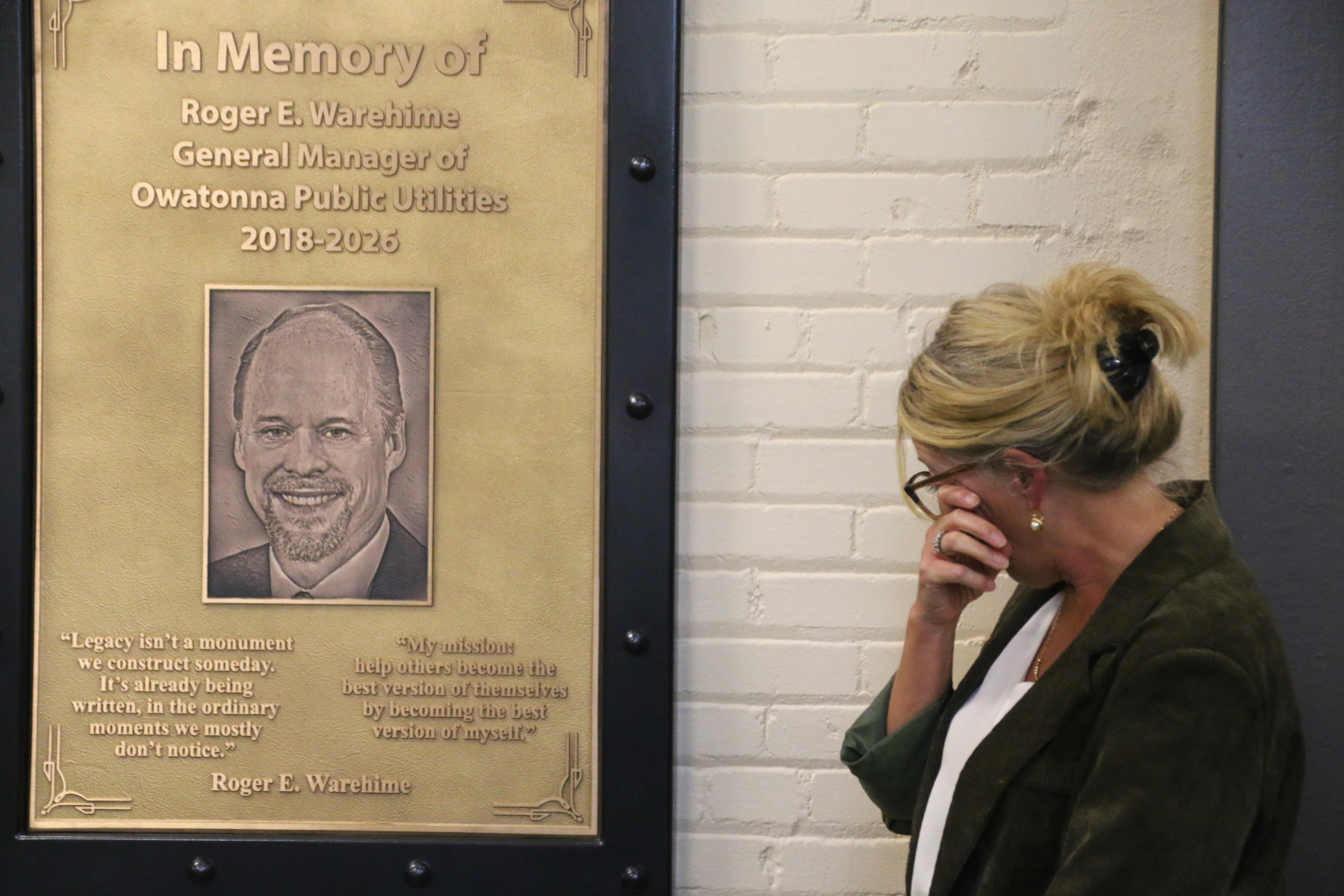
Kristin Warehime, wife of the late Roger Warehime, wipes away tears during the unveiling of a plaque honoring his 22 years of service to OPU. It hangs in the lobby, just outside the newly dedicated Warehime Community Room. Staff photo by Kay Fate
After the floodwaters receded in September 2010, revealing the damage done to Owatonna Public Utilities, the architects and leaders of the plant worked hard to repurpose as much as they could.
The wallpaper behind the desks at the entrance featured the original blueprints of the 1924 building, said Kristin Warehime.
“The grating on the guardrails used to be the flooring, I believe, from the old power plant,” she said.
Many small relics and items were saved, Warehime said, to remain part of OPU’s history.
“And now, Roger gets to be part of this building’s story.”
Roger Warehime worked at the plant for 22 years, serving as general manager from December 2018 until his unexpected death from a heart attack in April.
On Oct. 8, more than 100 people crowded into the newly named Warehime Community Room just off the lobby of OPU, where a plaque in his honor was also unveiled.
“Roger was a staunch advocate for this room being open to the public as much as possible,” said Christian Fenstermacher, who was named Warehime’s successor in July. “He cared deeply about this community. He’s been giving people a place to come together, to share perspectives and ideas, and to figure out how to work together. That’s what this room is for. That’s why it should carry his name.”
Two of Warehime’s good friends – Brad Meier, president and CEO of the Owatonna Area Chamber of Commerce, and former Owatonna Public Schools Superintendent Jeff Elstad – also spoke.
“He was and is the best listener that I ever knew, often annoyingly so, and he’s a pro’s pro with strategic planning – also annoyingly so,” Meier said. “When you had a conversation with Roger, there was nothing superficial about it.”
He was not only good at strategic planning; he liked it, Meier said.
“Every organization in this town is better because of Roger’s skill and generosity … his ego-less generosity that he would give to basically every individual he would try to help, every organization that he would participate with, and ultimately a community that he loved so very much.”
Elstad’s remarks had a similar theme, “because Roger was consistent.”
Warehime also understood “the awesome responsibility of leadership,” Elstad said, always taking notes during presentations because “somewhere, somehow, that was going to impact somebody else, because Roger had an amazing skill of turning that into something extraordinary” for people or groups he was working with.
“He was constantly putting others before himself, and giving others exactly what they needed,” Elstad said.
“Unfortunately, in our society, the word ‘inequity’ has been co-opted,” he said. “Equity means giving people what they need, and Roger was an equitable leader… He had an amazing ability to listen and value differences; he was never afraid of a difficult conversation, because he would listen authentically.”
Elstad encouraged the attendees to “honor Roger’s mission of validating and valuing differences, and being OK with that… We have to make sure that at least we’re on the same path toward understanding that we don’t all have to believe the same things, and we can be different. I want us to honor that listening, that leadership, the spirit of discussion and the art of compromise that Roger was willing to help us find.”
Another good friend, Kent Myers, who provides leadership training to OPU staff, talked about a table Warehime built for Thanksgiving dinner, “large enough for everyone to sit together. He didn’t want anyone left out, or sitting at a separate table. He wanted everyone to have a place.”
Myers called it a fitting story for the dedication, “because I hope this community room is filled with tables – not just of wood or metal, but tables made from the things Roger gave us so freely, and that he gave freely to others: Inclusion, empathy, kindness, respect, caring.
“I hope conversations happen here that bring people together. I hope differences are welcome, voices are heard and no one ever wonders whether there is a place for them at the table, because that is what Roger did: He made room for people,” Myers said.
“He noticed people; he listened to people; he cared about people, and he understood something that every great leader eventually learns: Leadership isn’t about how many people sit behind you. It’s about how many people you are willing to make room for to sit beside you,” he said.
“May the conversations around these tables be dealt with respect, curiosity, laughter, compassion and care, and may everyone who enters this room feel that they belong here,” Myers concluded.
“Roger built a table large enough for everyone. May we spend the years ahead of us, making sure we do the same.”