


Judge, grads tout success at Capitol rally
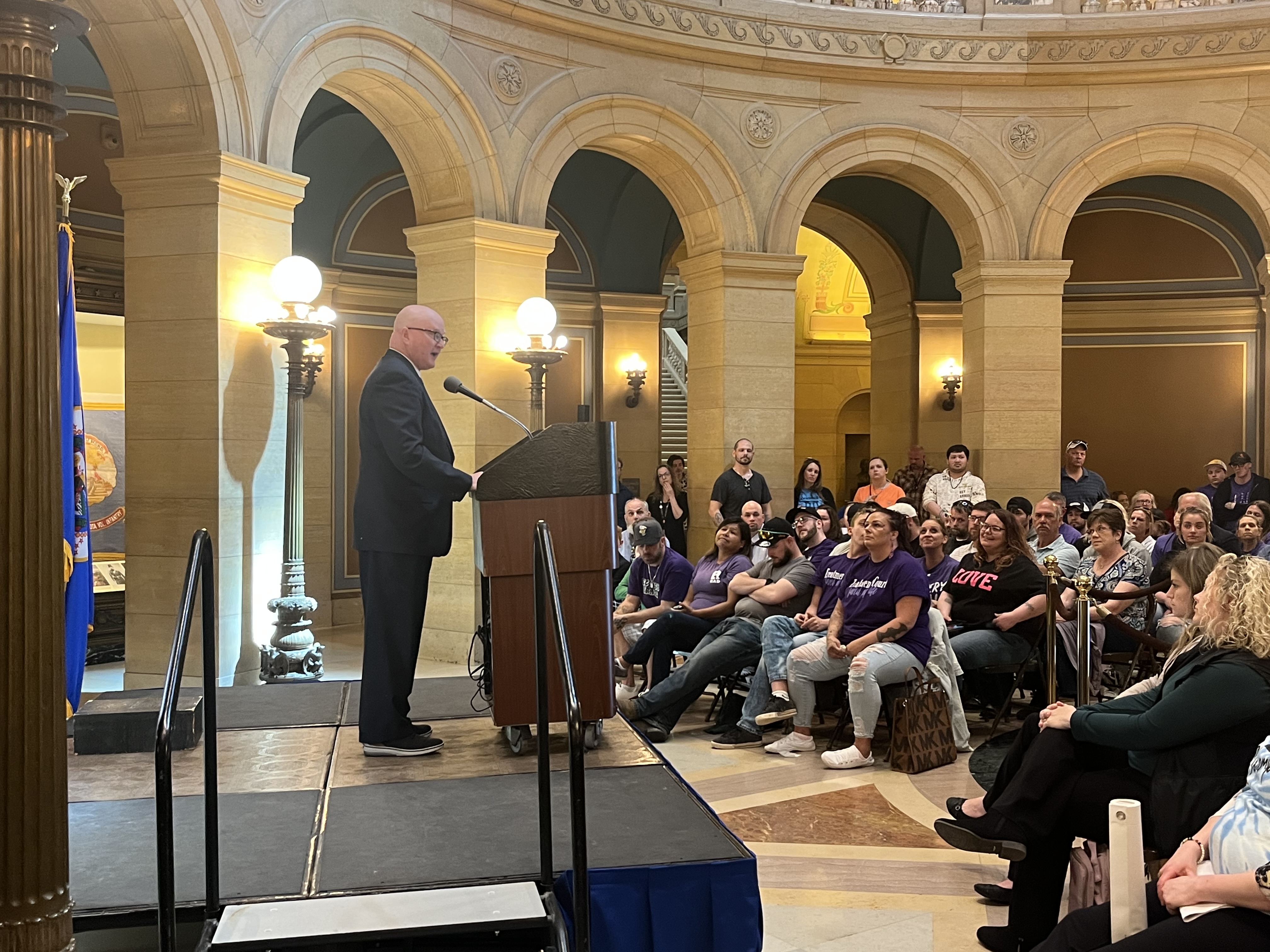
Lyle Sellers was good at lying, cheating, figuring out ways to get his next high. Even when on probation, he knew how to beat the system.
He was good at recidivism. He had been to prison a handful of times.
It’s how he described his years of battling addiction during a speech last week at the Capitol, where supporters, and graduates of various treatment courts in Minnesota rallied.
The event, in honor of Drug Court Month featured speakers from across the State, and the day was dedicated to speaking to elected officials to garner support and bring awareness to the various treatment courts across Minnesota.
Decision To Change
Sellers stood a few hundred feet away from Nicole Grams, the Steele Waseca Drug Court Coordinator when delivering his speech to approximately 150 people in the Capitol rotunda.
A recent graduate of Drug Court, his journey to sobriety began with a conversation with Grams.
Facing a sixth prison stint, Sellers faced a choice. Take a gamble with a judge or a jury or take a chance to get clean.
“The only thing promised to me was the chance for real change, and I was blessed for the opportunity,” Sellers said.
It was an opportunity he never thought of before. Something he needed to ponder on.
“For the last 20 years my life revolved around using drugs, and stealing, and manipulating, and cheating in every way I could just to get my next high,” he said.
He explained even when prison and probation forced him to get sober, he would stay legally compliant just long enough to pass his testing. This would be different, however. Drug Court comes with strict drug testing, check ins, rules need to be followed, and those who aren’t successful risk the punishments, including having their sentences executed.
“So, I thought to myself I could either do this and try and fail epically go to prison, or I could just go to prison right now and just continue that rinse and repeat cycle I’ve been living for the last 20 years,” Sellers said.
But after some thought, he decided he needed to change.
“It was very, very hard,” Sellers said of his journey within Drug Court.
Unlike a prison or jail sentence, which he said didn’t offer any change for people he said this was different.
“When you leave prison, they open the door and say ‘do better’ and in my case a few times they said ‘see you soon’ but when you graduate from Drug Court they congratulate you,” Sellers said.
When people get to the anticipated graduation day for Steele Waseca Drug Court, there to shake their hands, is Third Judicial District Chief Judge Joseph A. Bueltel.
Bueltel didn’t disagree with Sellers’ assessment saying “Treatment courts not only saves lives but saves money.”
“Rather than sitting in prison or jails, participants are productive members of the community, working jobs, chairing recovery meetings, paying rent, and yes paying taxes,” he told the crowd.
Bueltel, the co- chair of the Treatment Court Initiative Advisory Committee, has seen many graduates, with similar stories like Sellers come through his courtroom.
Simply put, it was a committee, created in 2008 to look at the short- and long-term systemic challenges facing the court, and how to handle drug and alcohol cases easier.
“At its most basic level, Treatment Courts are problem-solving courts,” Bueltel said. “If you solve a person's substance use disorder or mental health concerns (or both), many times the person's criminal problems go away.”
Touches Everyone
State Sen. Nick Frenz, DFL- Mankato, and a law school classmate of Bueltel, spoke at the event, not only as a lawmaker, but as someone who knows about the struggles of addiction, speaking about his daughter who is in recovery in California.
“I’m not just speaking to you as a legislator but as a dad,” he said.
He explained one of the things people can do to help is speaking to their legislators and telling them they want support, from St. Paul.
“When you meet with your legislator, say what you want, you want support, for recovery courts, for drug courts, for veterans courts. Why do we want it? Because it's the right thing,” Frenz said.
The State in part, funds treatment courts, like drug and veterans courts, something many supporters hope to see in every community in Minnesota.
Every County
In addition to Drug Courts, there are a number of different specialty courts in the State, including Veterans, DWI, and the list goes on.
For counties like Dodge and Steele, Veterans Court is part of the Third Judicial District.
But some counties in the State don’t have any type of treatment courts. It's something supporters of Treatment Courts hope to see changed.
“I'm proud to say there are 70 Treatment courts across Minnesota,” Bueltel said. “But there is more work to be done. There are 12 counties without a treatment court, The Court system has a strategic goal to provide access treatment courts across the state.”