


Native woman heals with help from her culture
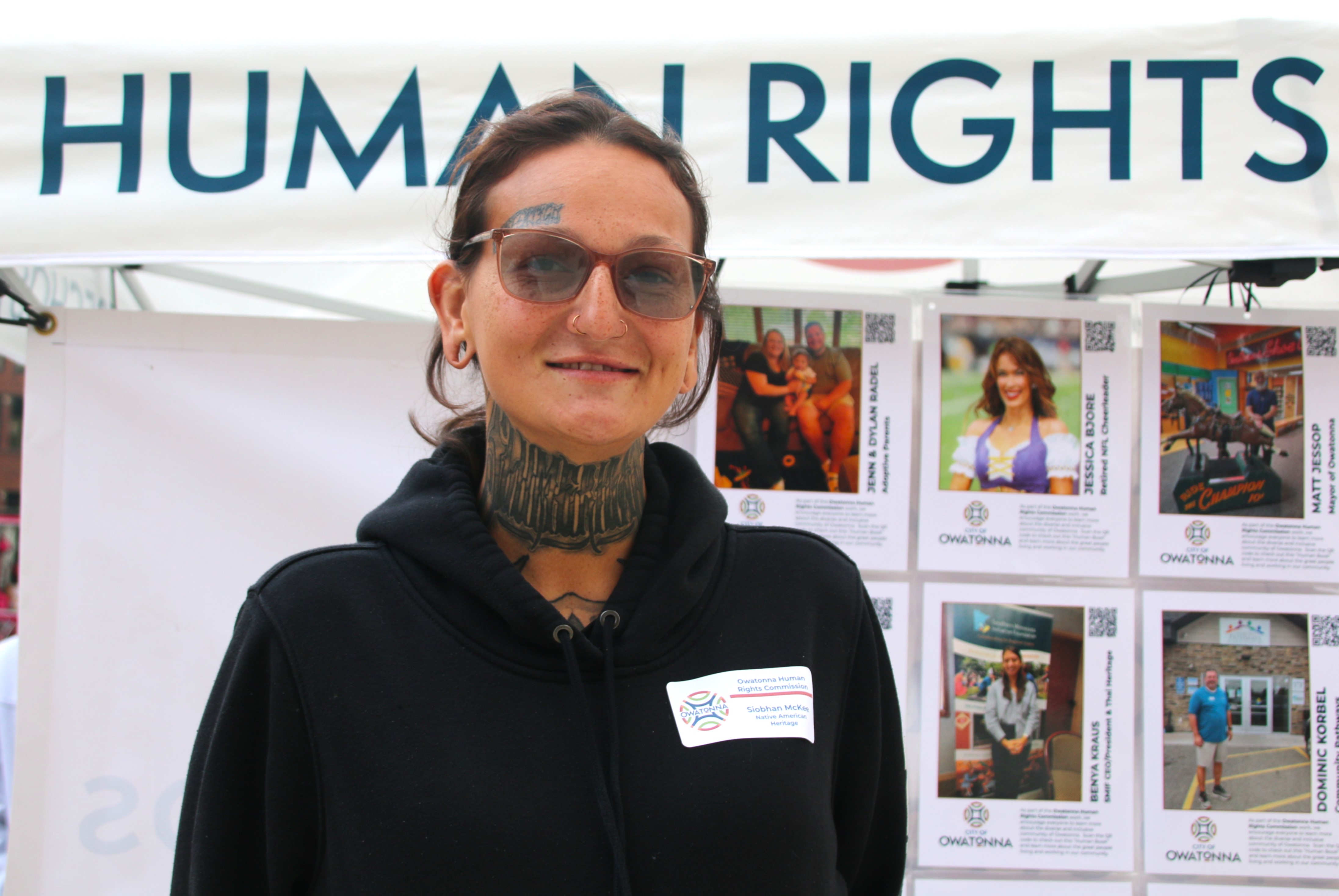
Siobhan McKee, who lives in St. Charles, was in Owatonna for the Sept. 4 “Human Library,” sponsored by the Owatonna Human Rights Commission. After spending time in foster care and coming to terms with her history, McKee is embracing her culture and her sobriety. Staff photo by Kay Fate
-Siobhan McKee, Dodge County Drug Court Team
Siobhan McKee is reclaiming her past – and her future.
As a Native American, the 32-year-old from St. Charles knew the odds were stacked against her; she heard it in the stories from her family members and saw it in her six years in foster care.
“My grandmother just recently opened up to me about her childhood,” McKee said, sharing stories of empty bellies and no food at a boarding school for Native American children in Wisconsin.
“She still doesn’t really know how she was part of the ‘50s ‘scoop,’” McKee said of the large roundup of Native American children. “She was told her family wasn’t able to take care of her, so they put her in foster care, but her sister was sent to a different boarding school.”
Money was scarce for the family, “so food was scarce,” McKee said. “Her family wasn’t given the same opportunity that Caucasians were in that time.”
The government-run schools separated children from their parents, their native languages, their native cultures and dress – even their names.
“What I experienced – which wasn’t that long ago, and what got me put into foster care – is not that different,” she said.
McKee was raised by her stepfather, and was taught “not to trust professionals, not to comply with anything they say,” she said. “Social workers aren’t there to help you, they’re there to take your kids away… I had a very negative outlook on anyone that wasn’t my family.”
Much like her great-grandparents, McKee said the help wasn’t available for her family, who lived on tribal land in Wisconsin.
Her father’s distrust of authority landed them in sketchy living situations; his alcoholism led to physical abuse and neglect.
Even the grim living conditions – no running water, no electricity – she said, didn’t really register.
“We didn’t know any better, right?”
She knows, though, that his behavior was a result of how his mother raised him – “and it just gave me a different perspective.”
At age 12, she and her siblings were removed from the home and placed into foster care.
“I was scared, but it was a blessing in disguise, I guess,” McKee said.
She eventually went through 10 different foster homes in four years, then aged out of the system at 18.
She was not prepared for the world, she admitted, and struggled with addiction. Her oldest daughter was removed from her custody against her will and placed for adoption.
Her case, McKee said, “has changed the way the Dodge County Attorney treats other cases,” she said. “It sucks that it had to be me to go through that, though, and be the example.”
The defining moment came “when I looked in the mirror and hated who I saw,” she said. “I had to change everything about myself.”
She has been clean from methamphetamine use for nine years, and everything else, including alcohol, for four years.
McKee is now a foster mom to her biological nephew and has two more biological children of her own.
She has worked at Recovery Is Happening in Rochester for almost two years, and is on the drug court team for Dodge County.
She is a homeowner.
McKee has attended training for Wellbriety, a Native American-based recovery path.
It was developed by Doy Coyhis, a member of the Stockbridge-Munsee Band of Mohicans.
“The indigenous experience adds a dimension of acknowledging sociopolitical causes, without removing an individual’s need to do the hard work it takes to heal,” Coyhis said.
McKee describes herself as “super-involved with my culture now. Something I learned in the (Wellbriety) training is that in order for us to live a healthy life as Native Americans, we have to go back to our roots, to our culture, to our practices and our ways.
“That’s something I’ve been really challenging myself on,” she said, by exploring things like native agriculture and medicine.
Her children “are immersed in everything;” her daughter danced in a powwow in late August, wearing a traditional jingle dress that McKee and her sister made.
McKee plans to make herself a new outfit “and chase the powwow trail next year.”
“So, yeah, reclaiming,” she smiled.