


STEM program puts Owatonna in the books
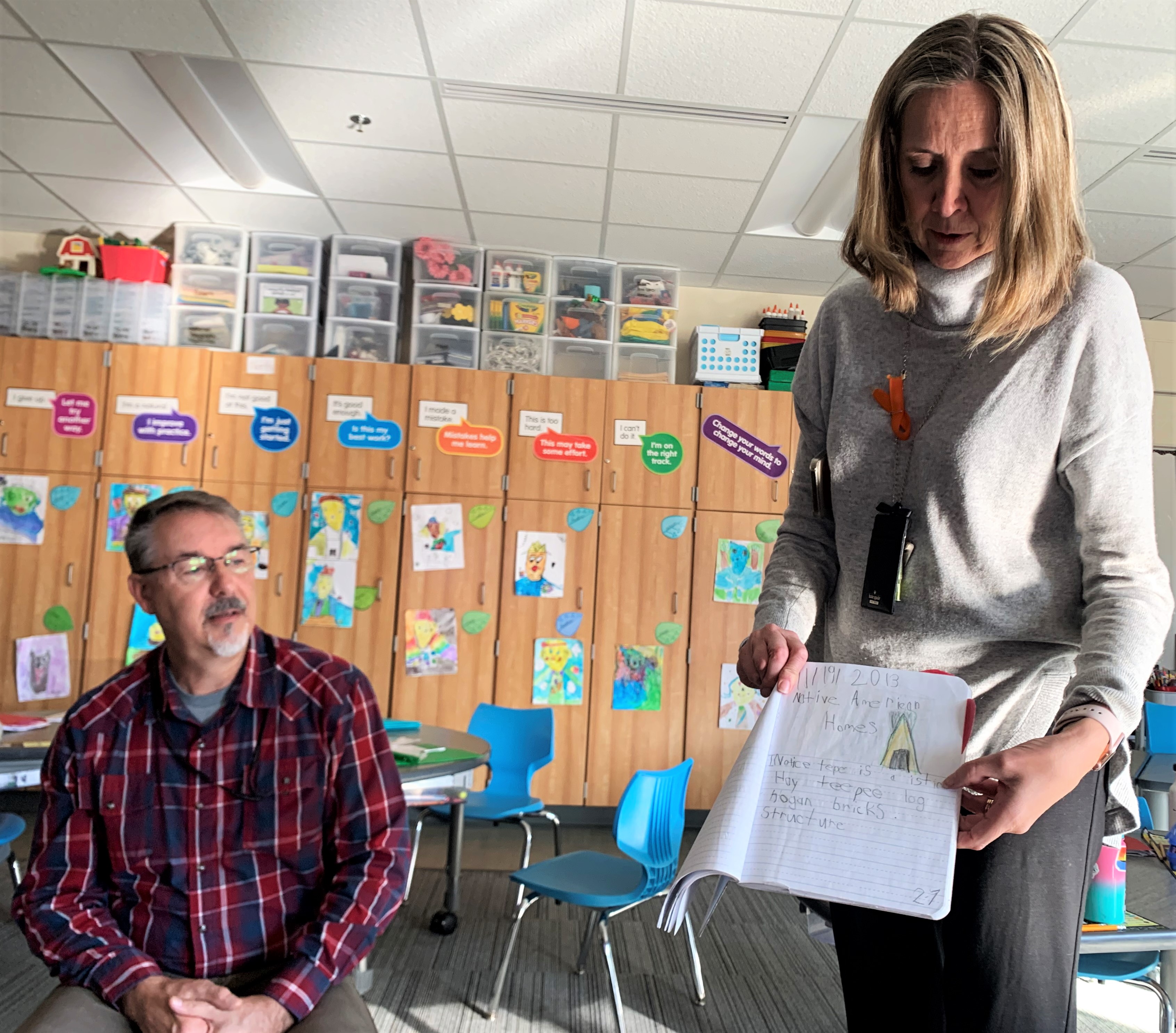
Michelle Simon, a first-grade teacher at McKinley Elementary School in Owatonna, shows the work done by one of her students during a unit on Native Americans. The students were asked to draw potential housing, describing how the materials would be collected and used. Simon and Tom Meagher, left, the STEM coordinator for the district, were asked to write a chapter about their methods for a textbook that will be used by future teachers. Staff photo by Kay Fate
When it comes to STEM learning – the umbrella term for science, engineering, technology and math – Tom Meagher wrote the book.
Or in this case, a chapter of it.
The STEM coordinator for Owatonna Public Schools, Meagher has his Ph.D. in science education from the University of Minnesota, where he has worked closely with the STEM Education Center.
About four years ago, the U of M asked “if we would be interested in publishing a chapter on how STEM works in the elementary classrooms,” Meagher said.
“When they asked, I said yes – as long as we’re including the teacher’s voice and getting the teachers’ stories of what’s happening in the classroom,” he said.
His first choice was Michelle Simon, who teaches first grade at McKinley Elementary School. The two have been working together to create elementary STEM curriculum since 2012.
The textbook, compiled by professors from Purdue University, was published this fall, complete with photos of Simon teaching McKinley students in their Owatonna classroom.
It will be used by undergrads for elementary science and STEM methods coursework. Meagher and Simon included reflective and discussion questions for the college students at the end of their chapter.
“So, what Michelle has done might be impacting the way first grade is taught nationwide,” Meagher said. “To have somebody of her caliber share what she does in her classroom I think is just going to benefit kids everywhere. She is the model.”
“It’s what we’re all doing,” Simon replied, brushing off the compliment.
They intentionally approached the chapter through the concept of storytelling, rather than a compilation of instructions.
“We were writing for pre-service teachers,” Meagher said, “so you want to get them excited to teach this way. It allows them as teachers to have a growth-mindset, because you’re going to fail – then learn.”
Getting onboard
“I did not love learning until I did this … learning from Tom and from our STEAM certifications,” Simon said, adding the “art” piece of the umbrella. “It made learning engaging and fun and active.”
And different: The lesson revolves around the learner, not the teacher.
“They’d ask the questions, which would drive the lesson. It made engagement so much higher,” she said.
McKinley is considered the “STEM school” in the district, but all other elementary schools are incorporating it into their coursework. More than 60 teachers have gone through the STEM certification process.
“As you see the value in it, and you see the student engagement,” Simon said, “the teacher buy-in is almost automatic. It’s a fun way to teach.”
McKinley Principal Justin Kiel, she said, “has provided hours for integration, to allow us to talk and create and bring together curriculum to integrate it through the day, and through different subjects.”
The Owatonna Middle School also has a STEM focus, meaning the introduction at the elementary level is important.
The collaborations are “natural for teachers – and for the students,” Simon said. “It connects them with their humanity.”
How it works
The premise of STEM learning is straight-forward in Simon’s classroom.
“We start off with, ‘what do we know and what do we wonder?’ Then we go from there,” she said.
There is a process: Ask, imagine, plan, create, test, improve.
“You can apply that in any field – and in first grade,” Simon said.
A recent social studies unit about Native Americans had the students out in the school’s nature center, collecting materials to use for potential shelters.
“Then we bring them in and look at all of the engineering pieces, and the process it will involve,” she said.
“We’ve had a belief for over a decade now that STEM isn’t just science, technology, engineering and math,” Meagher said. “It’s really how do we learn the world scientifically, how do we view technology, and how do we solve problems? Math is learning how to be precise in whatever we study.”
One of the most fascinating units they’ve done was about fairy tales, he said.
“How do we STEMify fairy tales? Michelle’s team came up with the idea of, how do we make magic real? And that led to the idea of demystifying magic with science,” Meagher explained.
“But still keeping their first-grade hearts,” Simon said. “It’s not to squelch the magic, but to use the magic to excite them about learning and to be part of the questioning process, not to eliminate creativity and imagination.”
Or, as Meagher said, “to show students how to really study the world, look at the world and not be fooled.”
Rumplestiltskin became the focus.
Put into practice
Reading the story about the imp who could spin straw into gold, the students began to look at weaving and fibers, Simon said, “and trying to understand how things that appear gold aren’t really gold.”
What the teachers learned, she said, “was that (the students) had more questions, so all of a sudden, we’re looking at a periodic table to see what gold was. Then we partnered with a middle school teacher and learned how to card wool, how to make yarn, and the spinning process.
“It was stimulating minds and motor skills,” she smiled.
More evidence, Meagher said, that “STEM is how we teach and how we learn; it can be applied to any subject. It fit in really nicely with language arts and fairy tales: The kids can see what appears to be magic, but what is real? And how do we reconcile the two?”
The students also write and draw in notebooks, “bringing in artistic elements, as well as understanding scientific sense of scale and accuracy,” Simon said of the process. “They’re required to write and reflect, so they develop not only prose, or creative writing, but they also learn how to write technically.”
That brings an unexpected benefit: inclusion.
“It’s awesome,” she said, “because the (English Language Learner) students and the English-speaking students are learning the technical language at the same time. The empowerment of the concept is occurring at the same time, so the ELL students don’t feel” excluded.
The results
Meagher believes STEM learning “pits growth mindset against fixed mindset. It teaches kids to see that failure is good and is actually a step that we grow from. It removes that sense of defeatism.”
It’s also unpredictable, “and not always clean,” Simon laughed.
But the Owatonna program is turning heads.
“By the time the kids are reaching middle school and high school, their engagement in the classroom, their discussion, their ability to be independent, their teamwork and conceptual understanding is more highly developed than their peers’,” Meagher said.
So much so, that the U of M STEM Education Center coined a phrase for it after interviewing students, teachers, and community members who went through the district’s STEM learning.
“They call it the McKinley Effect on students,” he said. “They’ve published that. They find it especially in kids who have been here for multiple years at McKinley, because it’s consistent among multiple grade levels.”
And now, prospective teachers will be able to take advantage of the McKinley Effect themselves, thanks to the college textbook with a little slice of Owatonna inside.
“Did I tell you?” Meagher asked Simon. “I’ve heard back from the publisher and some preliminary users of the book, and ours is like one of the favorite chapters. How about that?”