


11 area vets receive Quilts of Valor in BP
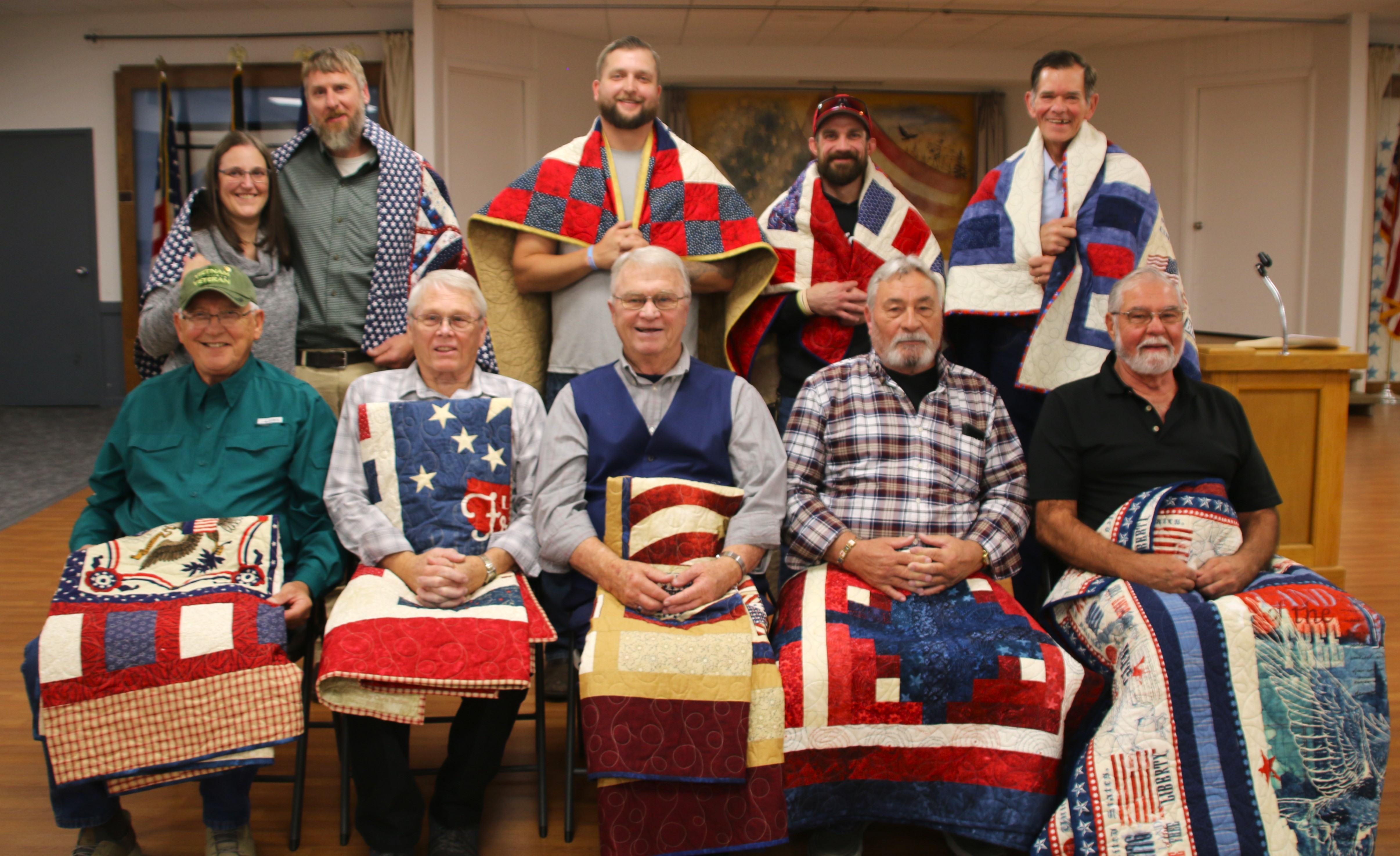
Ten of the 11 veterans who received a Quilt of Valor from the Blooming Prairie American Legion are shown with their new quilts. Seated, from left, are Mike Mestad, Bob Holtan and Craig Bauman, all of Hayfield; Leon Wilcox and Jerry McCloud, both of Brownsdale. In the back row, from left, are Kelly and Landon Peterson, of Owatonna; Anthony Cornell, of Blooming Prairie; Tracy Millner, of Austin; and Thomas Watson Jr., also of Blooming Prairie. Not pictured is Jonathan Miller, of Waterville. Staff photo by Kay Fate
It’s a big number that keeps growing, made all the more remarkable by the small group responsible for it.
The Blooming Prairie Quilts of Valor group presented quilts to 11 area veterans at its annual ceremony Saturday, bringing the total of handmade awards to 388. Spearheaded by the American Legion Auxiliary, it was started by Christine Butler in 2014.
The quilts presented last weekend were all pieced and quilted by six community volunteers, including Butler, Diane Anderson, Shirley Nelson, Linda Christianson, Bev Hoveland and Marilyn Meshke.
Becky Miner, of Sportstitch & More, created the label each quilt carries, complete with the veteran’s name.
Landon and Kelly Peterson, who met while serving in the Air Force, will share their quilt.
Landon, who retired after 25 years in the service, made nine deployments; he was a mechanic on fighter jets before transitioning to work on drones.
Kelly Peterson served for 15 years as a dental technician, including stints overseas.
The couple now lives in Owatonna.
Tracy Millner, of Austin, enlisted in the National Guard with seven close friends while they were still in high school. It was the terrorist attacks of Sept. 11, 2001, that prompted the decision.
His unit spent time in Kosovo, as well as doing border patrol. Millner served from 2003-2011.
Anthony Cornell, of Blooming Prairie, is a current member of the Army National Guard; he is five years away from a 20-year career. He spent about a year at Guantanamo Bay; trained in North Macedonia and served a tour in southern California, on border patrol.
Cornell is a member of the 34th Military Police Company out of Stillwater, where he was been in the same platoon and unit his entire career.
Leon Wilcox was a member of the U.S. Army from 1972-75, serving with an engineer company. He spent some time in Germany, and called the Quilt of Valor “a very nice honor.”
Jerry McCloud was classified 1-A before he even graduated from high school, he told the crowd after receiving his quilt, “so I knew where I was going.”
It was 1967, so that meant one thing: Vietnam.
Instead, he stopped by the Air Force recruiter’s office in Austin, where McCloud was told that if he signed up, he’d receive a year’s delayed enlistment.
“When you’re 18 years old, a year’s a long time,” he said, “so I signed up.”
Instead of landing in Vietnam, he was sent to Germany, “and that’s kind of where we got into our traveling mode, and have been doing a lot of that ever since,” McCloud said.
He was an aerospace medical technician, working in the hospital, at the flight surgeon’s office, and responding to any flight line emergencies. He flew in B-52s, 135s, helicopters, C-47s and more.
McCloud spent nearly 11 years in the service, from May of 1968 to March of 1979, when “I decided to get out because I got tired of moving the kids around,” he said.
Robert Holtan attended vocational school in Austin from 1966 to 1968 with an eye on becoming a carpenter. Shortly after graduation, though, his draft number was pulled: 4 – with two before him who had volunteered.
“But a Navy recruiter came to the school, painted a really pretty picture of what we’d be doing,” Holtan said, “so I signed up for 30 months and went in as an E4.”
After basic training, he was attached to a mobile construction battalion in Rhode Island.
“Three months and one day after being sworn in, I was on a plane headed for Vietnam,” Holtan said.
The entire battalion – 1,000 men – would move together “as a construction company, basically,” he said. “We had carpenters, electricians, plumbers, equipment operators, office personnel” and more.
They built helicopter hangars, control towers and barracks, always with a helmet, a protective jacket and a weapon with live ammunition to protect themselves.
He eventually returned to Rhode Island, where he was assigned to riot duty, “and guess what we were issued?” Holtan asked. “A helmet, a protective jacket, ammunition – and I went from an M-16 to an M-14 with a bayonet, just to defend our base.
“It took me a while to wrap my head around the fact that they would send somebody from a warzone right back to the States and give them live ammunition to defend our base there,” he said, growing emotional.
“That’s why I really appreciate this quilt, because as others have said, you just didn’t get a thank-you when you came back,” Holtan said. “You came back and blended in and moved on with your life.”
Craig Bauman also had a low draft number: 34. Though he figured he’d follow in his father’s footsteps and join the Air Force; the Army recruiter offered three years instead of six.
He went in as a telephone lineman, and learned about a re-enlistment bonus of $14,000 – then learned the linemen that were sent to Vietnam were often shot by snipers.
Bauman’s orders changed as the forces were reduced overseas; he was sent to Ansbach, Germany. During his time there, the 1972 Summer Olympics in Munich were disrupted by a Palestinian militant group, which broke into Olympic Village.
Five athletes and six coaches were killed, as was a German police officer.
As a result, Bauman said, the base at Ansbach was on high alert for weeks. He served from 1971 to 1974.
Mike Mestad was in the Army from 1969-1971; he was sent to Vietnam in the fall of 1970.
“One thing that stands out in my mind is, on February 15, 1971, I turned 21,” he said. “I remember I saved some C-ration canned peaches and a pound cake in a can, and that was my 21st birthday celebration.”
Thomas Watson Jr., of Blooming Prairie, joined the Air Force in 1981 after watching his own father serve for 20 years.
He was in aircraft maintenance, handling aircraft that were traveling cross-country.
“I got to see everything from every branch of the military: Army, Navy, Marines, Coast Guard, and it was a lot of fun,” Watson said. He then cross-trained into computer maintenance.
“My biggest memory is looking back, many years later, and going, ‘do you realize we, as young people – 19, 20, 21 years old – are entrusted with the equipment and the responsibility?’ It really was a lot,” he said.
“You’d really be hard-pressed to get that kind of experience and exposure anywhere at all, and I’m very thankful for that,” Watson said.
He was honorably discharged in 1987.