


Authors talk about veterans in crisis at Owatonna Arts Center
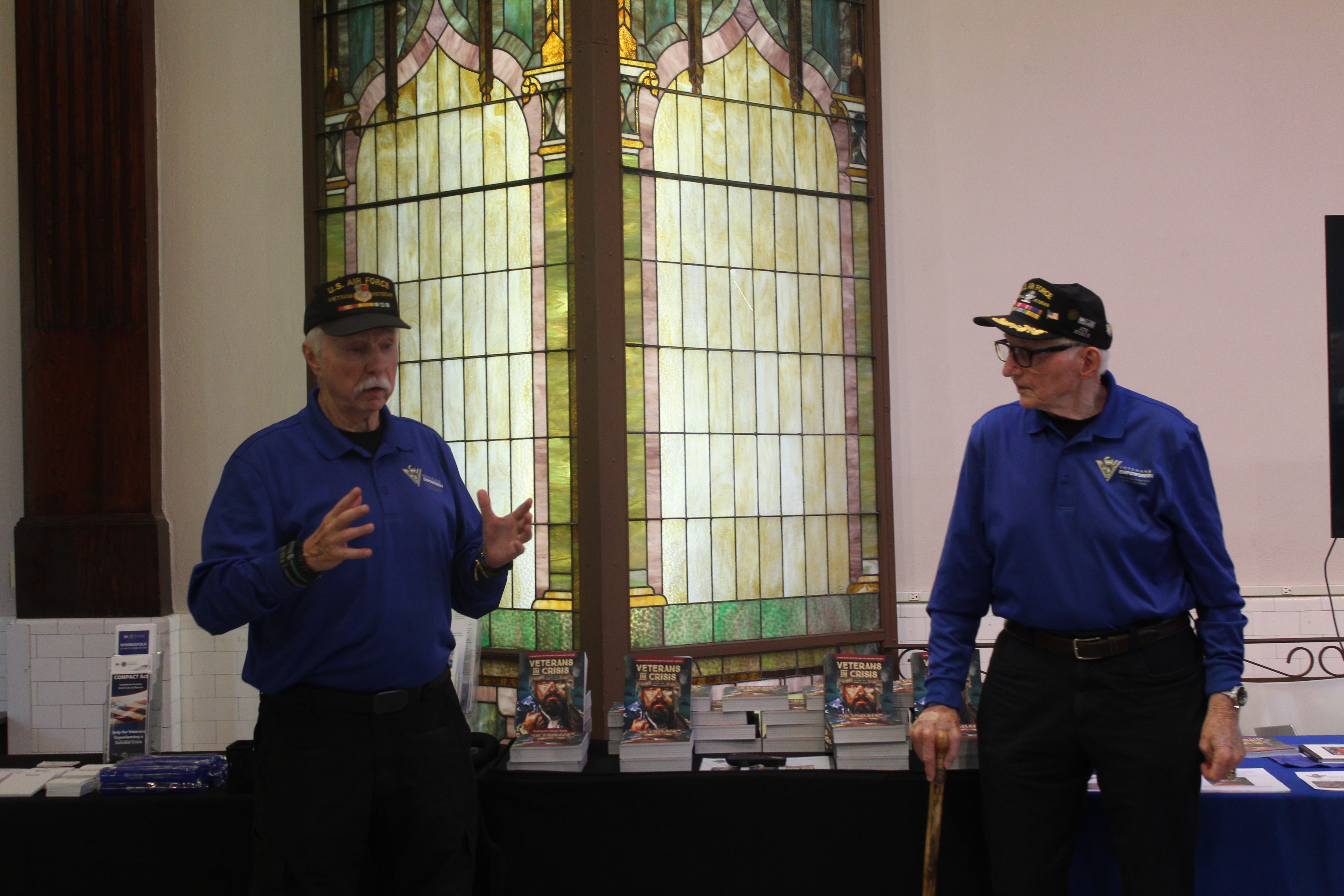
Dr. Steve Lansing and Col. B. Wayne Quist explain the work of Veterans Empowered! Staff photo by Karen M. Jorgensen
A small group of Owatonna residents gathered at the Owatonna Arts Center Saturday to hear a presentation on veterans living with post-traumatic stress disorder (PTSD), a look at PTSD from a historical perspective, and preventing suicide.
The event, presented by Veterans Empowered, featured Dr. Seve Lansing, a licensed mental health professional from Rochester, and Col. R. Wayne Quist, USAF Retired. The two men, who founded Veterans Empowered, are the authors of the three-volume series “Veterans in Crisis.” Both the books and the Veterans Empowered group is meant to serve the unique needs of those who served in the military and suffer from PTSD. The program was geared not only to veterans and their families but also first responders and their families and the general public.
Both Lansing and Quist are Air Force Veterans. Lansing was active duty from 1966 to 1972 and served in Vietnam from 1968 to 1970. After retiring from the service in 1972, he earned a Ph.D. A licensed mental health therapist specializing in trauma and PTSD, he is the president and executive director of Veterans Empowered in Rochester and the mental health specialist for the Third Judicial District Veterans Treatment Court.
Quist served in Vietnam from 1964 to 1968 and the Middle East from 1968 to 1989. He has advanced degrees in management, history, international relations and psychology. He is from Northfield and has a B.A. from St. Olaf College and advanced degrees from the University of Southern California and the National War College in Washington D.C. He is secretary/treasurer for Veterans Empowered and is in long-term PTSD recovery under Lansing’s care.
At Saturday’s event, they discussed their three books, which deal with PTSD throughout history; Joe’s Story, which is the story of Quist’s uncle; and the most recent book, a PTSD analysis of Jesse James and his gang in Northfield in 1876.
Lansing told the group that the purpose of Veterans Empowered it to help veterans who suffer from PTSD and primarily those who live in rural Minnesota. Eighty-five percent of the providers who treat individuals with PTSD, he said, are located in the Twin Cities, leaving the rest of the state underserved. While the most quoted statistic is 22 veteran suicides a day, the real number is probably higher.
While the main mission of Veterans Empowered, he said, is to help those with PTSD, the long-term goal is to stop veteran suicides.
The impact of trauma suffered during military service, Lansing said, can continue throughout the veteran’s life. He runs into veterans his age, he said, who have suffered silently from PTSD ever since their service decades earlier.
The first book, he said, has been distributed free to 10,000 veterans.
Veterans Empowered, he said, has also embarked on a new mission, helping those in the Ukraine who are suffering from PTSD.
There are about 800,000 combat veterans from the Ukraine war, he said, and it is estimated that the prevalence of PTSD is 20-30%. The country also has many orphans and children facing the trauma of war. The White Bear Lake Rotary, he said, hosted a delegation from the Ukraine, who talked about the issues faced there.
Veterans Empowered, he said, is now working with the White Bear Lake Rotary to get funding to translate the first book into the Ukrainian language and distribute copies there.
Much of Saturday’s program centered around Joe Haan’s story and life dealing with PTSD. Haan was Quist’s uncle, who lived in St. Paul until his mother’s death in 1925. Joe’s oldest brother, Danny, was 16 and joined the Army. The next oldest child, Kenny, went to live with an uncle, attended high school, worked his way through Macalester College, served in the military and attended Harvard after the war.
Joe and his sister, however, had nowhere to go, and they were sent to the State Orphanage in Owatonna.
As was customary, the two where “farmed out,” Joe to work for a local farmer and his sister, to work for the headmaster at St. James School in Faribault.
For Joe, Quist said, this meant working for a “mean” farmer who routinely mistreated him. His sister, however, was in a totally different environment where education was encouraged, and she attended college after high school and became a teacher.
The trauma Joe suffered during his childhood was the beginning of his battle with PTSD.
As soon as Joe turned 18, Quist said, he left and farm and began the hobo life, but not before he hit the farmer with a two-by-four.
During his hobo days, Quist said, Joe often found his way to libraries, where the librarians treated him well and he learned to love poetry. After his uncle’s death, he said, he received his journals and the poetry he read there was “gut-wrenching and haunting.”
He traveled to the south and to San Francisco. After riding the rails, he returned to St. Paul in 1938 and joined the Civilian Conservation Corps (CCC). After Pearl Harbor, he went into the Army.
By that time, Quist said, he had already lived through trauma that included serving in Europe in Gen. George Patton’s Army at the Battle of the Bulge.
His uncle, Quist said, earned the Silver Star, Bronze Star and Purple Heart, yet he never earned a rank above E5 because “he couldn’t take orders.”
The PTSD followed him after the war when he went to New York and joined the Ironworkers Union, working in dangerous jobs.
His poetry showed the effects of the traumas, Quist said, although they were not recognized at the time.
Joe died in 1992, and Quist said when he received Joe’s belongings, including the poems, he knew he had to tell Joe’s story.
Jesse James also experienced traumas dating back to his father’s death when he was three years old. And many ancient philosophers, including Socrates, knew about the effects of battle on the human brain.