


‘Blossoms Forever’
It probably wasn’t planned this way, but the 2025 inductees into the Blooming Prairie Education Foundation’s “Blossoms Forever” all spoke about their education and their foundation.
Those honored included a graduate of the United States Naval Academy, a notable humanitarian, an All-American athlete, a precedent-setting relay team – and one man who had every one of them in class.
More than 120 people gathered last weekend to celebrate the distinctive service, athletic ability and outstanding education that came from the halls of Blooming Prairie Public Schools.
Their accomplishments lent credence to Superintendent Chris Staloch’s closing remarks following his update on the district.
“When our students leave Blooming Prairie Public Schools, they have an opportunity to pursue their dreams,” he said. “When our staff and families work together, along with community support, our students get a great education that sets them up for success.”
Doug Johnson
A 1977 BPHS graduate, Johnson received the Distinctive Service award.
Following his graduation, his academic and athletic achievements earned him an appointment to the U.S. Naval Academy, where he earned a degree in ocean engineering. Johnson returned to Minnesota and eventually retired as a respected design engineer at Truth Hardware in Owatonna.
His commitment to service reaches every corner of Blooming Prairie and Steele County, with countless hours devoted to the Owatonna Business Incubator, the Blooming Prairie Country Club, First Baptist Church and Blooming Prairie Ambulance. Johnson has served as a Steele County Commissioner, Servicemen’s Club and Prairie Manor board member, youth wrestling coach and referee.
He continues to assist his wife, Tamzen, in her accounting firm.
Still, “I really struggled as I reflected on this award and what distinguished service meant to me,” Johnson said in his acceptance speech.
He cited the support of his parents, brothers and extended family, including his uncle, Bob Oswald.
“It was his naval service to our country in World War II in Korea … that started my quest to join the Navy,” Johnson said.
He represented the BP American Legion at Boys State and was elected to attend the national convention in 1976. The Legion also sponsored his Boy Scout troop, where “I observed wonderful leadership.
“My academic experience – well, we’re honoring one of the teachers I had, Dean Meshke,” Johnson said, adding several other teachers’ and staff names to the list, including Frank Vorlicek’s “one-of-a-kind teaching styles.”
He was “blessed with Don Narveson for mathematics and Ken Behnken for physics and chemistry,” which prepared him for the Navy’s nuclear power program classroom experience.
“In reflection, I can’t help but see how many people influenced my growth and development before entering the Academy,” he said. “They laid a foundation upon which I could succeed academically, develop as a naval officer and transition into the business world and work in our community.”
Johnson offered advice to those in attendance, reminding them of “the role we play in the development of our youth. Your efforts, no matter how seemingly insignificant they may be, may be key to a youth’s development,” and encouraging others to volunteer.
Christy Anderson
A 1994 graduate of BPHS, Anderson also received the Distinctive Service award.
After graduating from Gustavus College, she settled in Claremont, Calif., where she has become a powerful voice for refugee families and an example of what it means to live out service to humanity.
Anderson founded Claremont Canopy, an organization that supports refugee families through employment, education, health care and empowerment. She partners with community and business leaders and local government to ensure the families are equipped to not only survive, but to thrive.
It started when she met a woman from Syria, “and she had four kids and I had four kids,” Anderson said of her humanitarian work. “I saw her, and I could just see the fear in her face, and I know what she had already been through to get to this point – and I thought, ‘oh my goodness. I have to help her.’”
Anderson knew that after 90 days, refugee families no longer receive government help; the government depends on nonprofits to fill the gaps.
“I really had my hands in everything in Claremont,” she said. “Ask my kids; I know everybody, so I thought I could use my network to help” the families.
It was 2017, and Claremont Canopy was born.
Since then, the organization has served more than 250 families, more than 1,000 people from nine different countries.
Anderson is on the staff of a large organization called Miry’s List, harnessing the power of social media and grassroots networks to connect everyday people with opportunities to support refugee resettlement.
“This has definitely become my life’s mission, and I attribute that lot to the foundation I received here,” she said.
After a speaking engagement, Anderson was approached by a man who “found it surprising” that she came from “a really small town in Minnesota … that welcomes their neighbors and is based in community.”
The man said she had changed his perception of what it means to be from a small town.
“I think the foundation of Blooming has taught me to reach across the aisle, to find the commonality with others where you may not have something in common, like seeing a mom of four,” Anderson said.
“I don’t speak the same language, but I know immediately how she feels, how she wants her children to succeed, how she’s afraid, and she needs that friend – and so that is what I’ve done,” Anderson continued.
Families from Ukraine and Russia, Syria and Afghanistan, Venezuela, Colombia, Iraq and Iran “all know that I’m getting this award, and they were all so excited,” she said. “It means so much to the families I serve to know that my hometown and a place that I’ve talked to them about ... I’ve told them about you, and I’ve told them about my teachers and my family … and I want to thank you for that.”
Pat Sheedy
A 1975 graduate of BPHS, Sheedy was inducted into the Blossoms Forever Athletic Hall of Fame.
Known for his rare combination of speed and strength, Sheedy stands out as one of the most dominant football and track athletes in school history, named an All-Conference, All-State and All-American athlete.
He was the first Blossom to ever rush for more than 1,000 yards in a single season, and ran for 19 touchdowns in his senior season alone – a record that stood for nearly 40 years.
Sheedy led the team into the school’s first state playoff appearance, and was the first Blossom ever selected to a post-season honor when he was chosen for WCCO Radio’s All-State team.
“And here we are, half a century later, still talking about Pat and those Friday nights under the lights on the old Victory Field,” said Ron Thorson, who introduced Sheedy. “It’s the mark of a true legend, when the memories last as long as the trophies.”
For his part, Sheedy remains humble.
“I don’t remember half this stuff,” he said, “but some of my fondest memories of playing football was how it affected everybody in the community, and everybody got together.”
He spoke about playing in Ellendale, “and Highway 30 was all taillights and headlights. It was like a parade going to the game. Everybody was looking forward to that, and it was one of my fondest memories.”
Sheedy was also a standout in track – though sometimes reluctantly. He was asked to throw the shot put on short notice, and after an embarrassing first attempt, “I kind of got mad, and threw the dang thing like a baseball. It was enough to get third place,” he said, and to win the tournament.
He thanked his coaches and teachers who taught him the skills he’d use the rest of his life.
“I did take a visit to the school,” Sheedy said. “Beautiful. That thing is – I mean, what a great learning environment for our future. I’m very proud of this town, and I thank you all.”
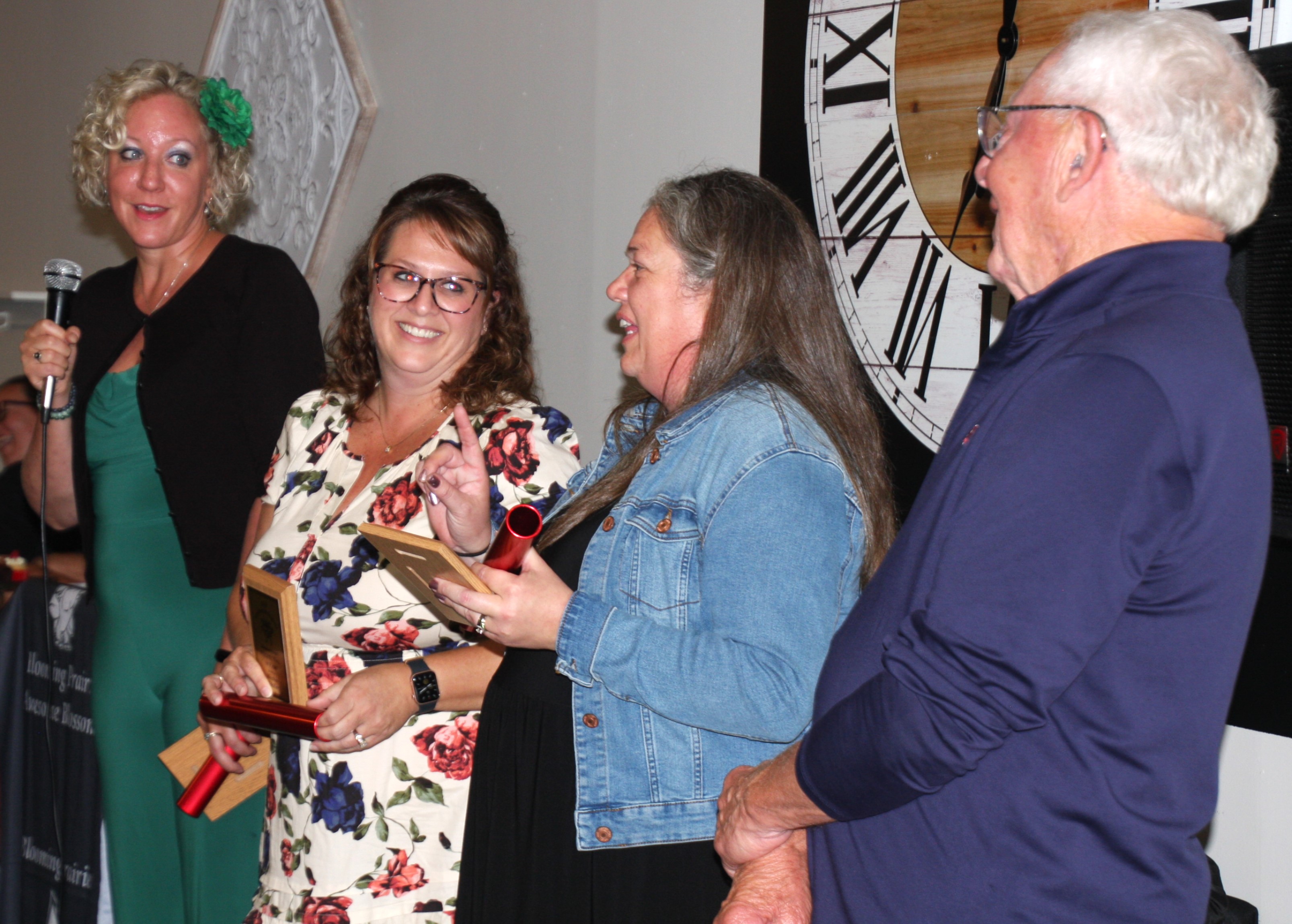
Heather (Bass) Schiller, Maren (Peterson) Gardner, Katrina (Olivo) Staska, Joanne Schlotzhauer
The four women were the winning combination for the 1997 girls’ 4x100 state champion relay team and were inducted into the Blossoms Forever Athletic Hall of Fame.
Their win came in the final year of coaching for Ken Behnken, who nominated them and introduced them last weekend.
“I nominated these girls, because I said, ‘We gotta do this now because I might not be around next year.’ I’m 84 and I’m still playing golf,” he said, “but I’m not running anymore.”
“Neither are we,” Schlotzhauer said.
Schiller and Gardner, both 2000 graduates of BPHS, were just freshmen during that state title run.
Staska, who graduated in 1999, was a sophomore; Schlotzhauer was the lone senior.
The season began humbly but with promise, Behnken said, holding up colorful signs with the team’s progressively decreasing times.
After winning their first race with a time of 54.6 seconds, they eventually stormed through sections with a blistering 50.95, earning a trip to the state tournament with a new school record.
Despite a reconfigured track shape and different exchange areas at the state tournament, the team broke its own record with a time of 50.29 and a place at the top of the podium.
Behnken presented the women with batons identical to the ones they used in 1997; he had their names and times painted on them.
Dean Meshke
Meshke was the only honoree who did not graduate from BPHS – but he taught all the winners. A teacher at BPHS from 1970-2005, he received the Outstanding Educator award.
His teaching style was unique and unforgettable, taking complex math problems and making them approachable, often weaving in his signature humor to keep students engaged and smiling.
Outside of the classroom, Meshke dedicated himself to coaching various sports teams, modeling teamwork, discipline and leadership for his student-athletes, shaping young people into well-rounded, confident adults.
He used that trademark humor to keep the audience rolling, beginning with a story about his daughter, Lisa, a 2000 BPHS graduate who is already a member of the Blossoms Forever, thanks to her golfing accomplishments.
“I would always ask her for help with my golf game,” Meshke said, “and she would just kind of shake her head. And I heard her one day tell her mom, ‘I don’t think Dad’s teachable.’”
She was talking to Marilyn Meshke, “a dedicated, hardworking, retired elementary teacher,” her husband said. “We’ve been married 52 years.”
As the applause died down, Meshke shook his head.
“She’s not clapping, though,” he said, drawing more laughs. “I would think that qualifies her for sainthood.”
Meshke signed a contract for $7,200 that first year of teaching, believing he’d be there for just a year, while Don Narveson pursued his master’s degree.
He rented a room in the basement of an elderly widow for $35 a month.
On the first day of school, a set of twin boys came to school late – and drunk.
“They didn’t go to class,” Meshke said. “They went up and down the hallways, kind of shouting nasty comments at people. They didn’t say anything to me, because they didn’t know who I was, because it was my first day.
“I thought to myself, ‘What have I got myself into?’ But I always had that basement apartment to go back to,” he said to more laughter.
As a 24-year-old, Meshke said, “I just remember my nickname – this is funny – was Lean, Mean Dean. Lean, Mean Dean. Now, the mean, my doctors took care of that; they got me on the right medicine. And I think all of you will agree with me that I took care of the lean, very efficiently.”
As the 70s wore on, “things got better,” he said. “The kids took more interest in their school, they took pride in their school. It kept getting better and better and better, and I even changed. I came to the realization one day that, you know, am I just going to teach math?”
That was when he began telling stories for them to relate to, “because they’re going to get out in life, you know.”
That was also when he really started to enjoy the students, Meshke said.
“You always try to make a connection with them,” he said, sharing some examples. “I think that’s what it takes nowadays. They don’t care what you know, they want to know that you care.”
Meshke thanked his family, then recognized the current teachers, administration and his colleagues on the Blooming Prairie School Board.
“We’ve got a good thing going here,” he said. “A really good thing. It’s going to take everybody working together to keep this ship rolling, because I’ve been here 55 years – and we are in the best shape I’ve ever seen.”