


BP moves to fix aging roads
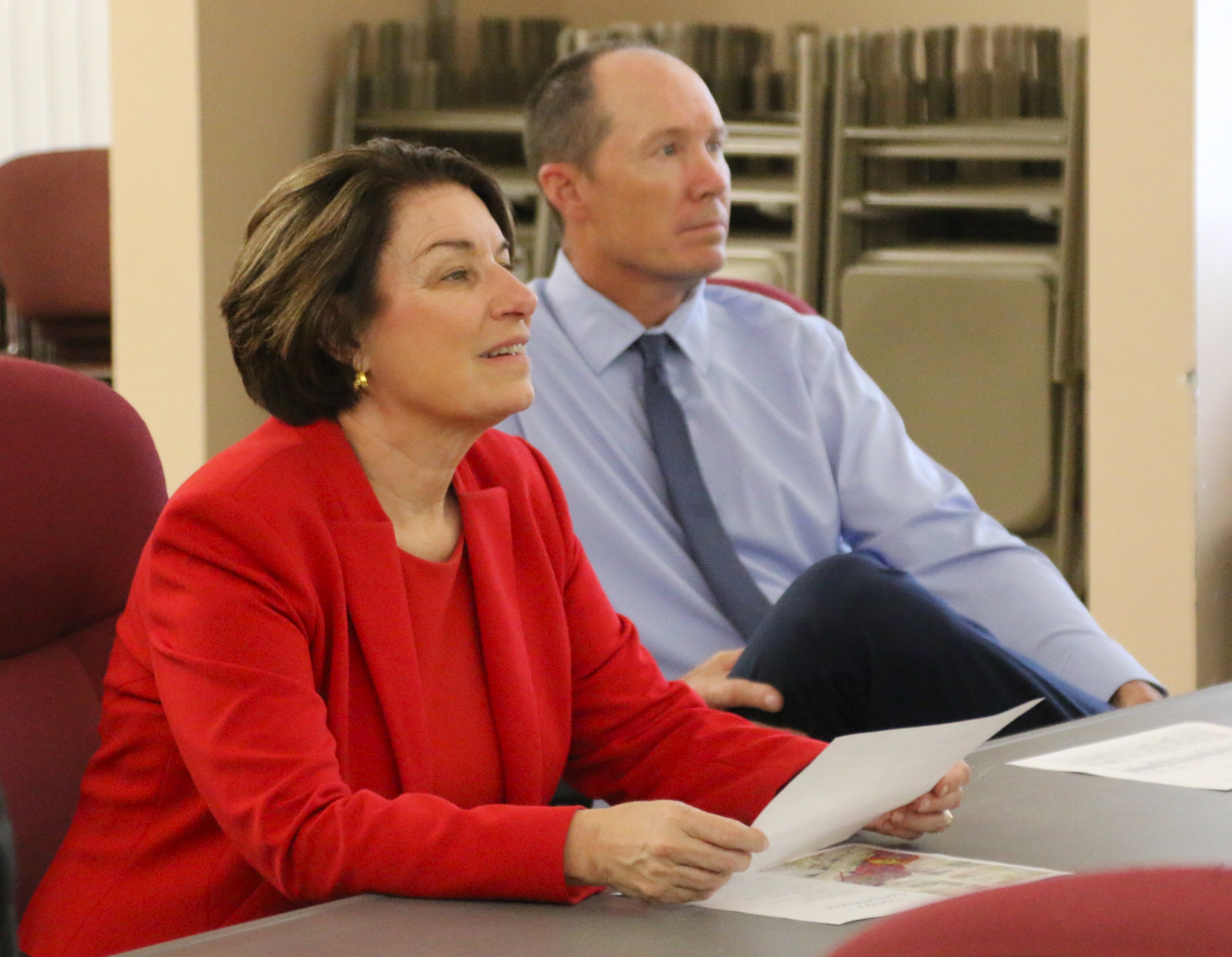
U.S. Senator Amy Klobuchar and Blooming Prairie Mayor Mike Ressler listen to a presentation about the concerns with U.S. Highway 218. The price to remediate soil and water contamination through the highway corridor continue to rise; the work must be done before underground utility work can be completed. Staff photo by Kay Fate
U.S. Senator Amy Klobuchar was in Blooming Prairie last week, the latest elected official to hear Brett Grabau’s explanation of the city’s ever-growing need for funding.
It was the fourth time in two years the BP city engineer has given the presentation that outlines how a seemingly simple road project has turned into a multi-million-dollar crisis in the making.
At issue is the stretch of U.S. Highway 218 that passes through Blooming Prairie, which the Minnesota Department of Transportation has slated for reconstruction and reconfiguration.
“We’re talking about corridor and utility improvements, and contamination remediation through the city,” Grabau said.
MnDOT initiated the project scoping in 2018; soil tests in advance of the work revealed significant chemical contamination throughout the area, pushing the project back multiple times – as costs continue to mount.
The city had prefunded its portion of the design for the project, which includes replacing the public utilities’ water man and the city-owned sanitary sewer infrastructure. Both lie under the existing U.S. 218.
The water and soil must be treated when the new highway is constructed – all the way to the depth of a sanitary sewer line that will be 16 feet underground.
Relocating the lines is not feasible, and while state funds are available for help with petroleum remediation, no funding exists for chlorinated volatile organic compound contamination, the commercial/industrial waste that pollutes the groundwater and soils in Blooming Prairie.
The timing is crucial, because MnDOT’s road project provides the excavation work needed to reach the city lines, bringing down the city’s cost for its utility work.
“We’re getting to a point where MnDOT is just going to choose to say, ‘we have to replace the road surface no matter what, so we’re going to walk away; you guys have to do your stuff underneath on your own,’” said City Administrator Tony Martens.
Klobuchar was instrumental in securing $1 million in federal funding to help cover the cost of the water infrastructure improvement part of the project.
“I am obsessed with getting all these types of projects done,” Klobuchar said. “I mean, it’s not as glamorous as some things, but it has to get done. We have some obligation to our state, and to our people … we have to make sure that our kids and grandkids have safe water and safe roads.”
While that funding is a boost, it still leaves the city’s share at between $2.9 million and $3.2 million, depending on the inflation factors used. Only about a third of that is actual infrastructure cost – the remainder is the contamination remediation.
The state bonding funds cannot be used to pay for the remediation, Martens said.
The problem is, “Highway 218 is truly crumbling,” he said, and the city is at capacity for what it can borrow.
“OK, well, why don’t we at least call some people about this and figure it out?” the senator asked Megan Lahr, her state director. “Because I did do the million; I would like it to go for something.
“I’m going to talk to MnDOT and see what we can do, but the issue is, is it in the bonding bill?” Klobuchar said after the meeting. “That’s where it should be, and especially when we got the million dollars, that should give the (state) legislature some comfort.”
Her funding should help Blooming Prairie’s cause at the state level, she said.
“In a normal timeline, they would be, ‘oh, good, the feds gave money.’ They helped, so we should, too.’ It’s always a big signal.”