


Community Pathways seeing increase in calls for food
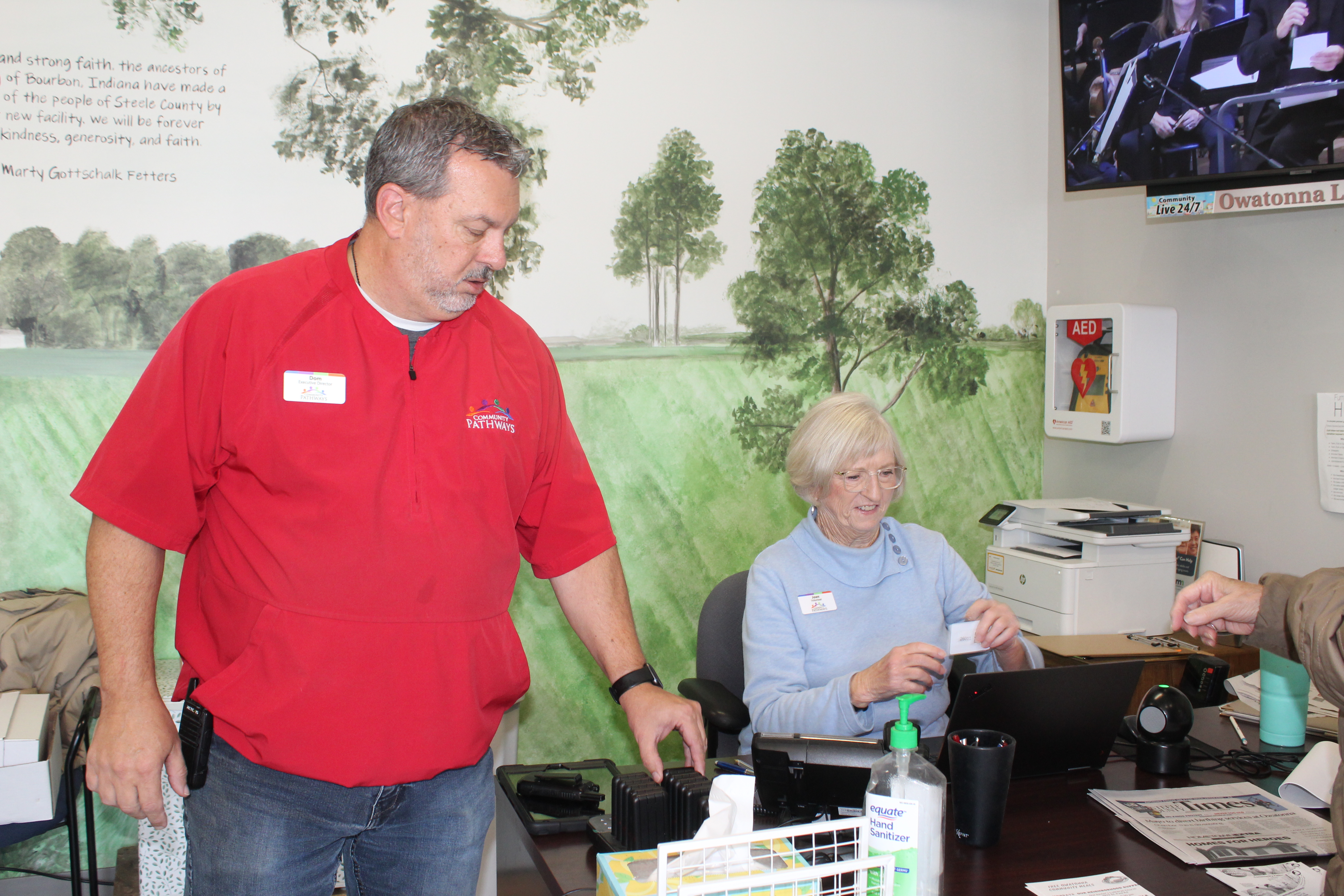
Community Pathways director Dom Korbel and volunteer Joan Erdman work at the front desk to meet clients at Community Pathways. Staff photo by Karen M. Jorgensen
When word went out last week that supplemental nutrition program (SNAP) payments may not be issued in November because of the government shutdown, staff at Community Pathways in Owatonna knew they would see an increase in people needing help.
And that is just what has happened, said executive director Dom Korbel.
“Tuesday night, SNAP users were notified they may not receive benefits for November,” Korbel said. “Instantly, we got phone calls.”
SNAP is the first line of help for many individuals and families in need, he said. Despite receiving benefits, many still need additional help and turn to Community Pathways to feed their families. A big question for the food shelf, Korbel said, is how many more people will need help.
“I just don’t know,” he said.
Roughly 2,600 families in Steele County access SNAP benefits.
“We serve 1,300 families a week,” Korbel said, adding a little under half also receive SNAP benefits. Community Pathways distributes 9,000 pounds of food on a typical day.
Korbel said the food shelf could see between 200 and 300 new registrations for next month. The number of people seeking help was rising even before the delay in SNAP payments.
All state food shelves are also finding that food is becoming harder to obtain.
Thirty percent less food is currently available from Channel One than last year, Korbel said. Based in Rochester, Channel One is the primary source of food for food shelves in southeastern Minnesota. Food can also be obtained from the federal Emergency Food Assistance Program (TEFAP). But that organization has lowered the amount of low-cost food available.
Donations of food are welcomed, Korbel said. Monetary donations aren't going as far they once did, due to the increasing cost of groceries, but have always gone further than food donations. One dollar donated, he said, can buy three times as much from sources such as Channel One than from a grocery store.
Korbel said people often do not understand who is receiving food help. While many in the community think clients and SNAP recipients are unemployed, he said, over 80% are employed either part-time or full-time. Only 25% receive help for more than three years.
“Most are short-term users,” he said, adding that about 11% are seniors and 37% are children under 18.
Partners, volunteers
With 10 paid staff members, Community Pathways relies heavily on volunteers and local partners, he said.
Just last week, a truck driver called to ask whether Community Pathways could accept 9,000 pounds of zucchini he couldn’t deliver. Korbel said with room for it and a loading dock, he was able to say yes.
Community Pathways can accept large donations like that, he said, “because the Owatonna community made this building possible.” The expanded building on Oakdale Street opened three years ago.
There is nothing wrong with the product itself, he said, but it is rejected by the recipient for a variety of reasons including if it was delivered to the wrong location or it was more than expected. The trucking companies also play a part, Korbel said, because they are willing to make the extra stop at Community Pathways.
In the case of the zucchini, Korbel said, Community Pathways was also able to share the donation with food shelves in Faribault.
For the larger companies, such as Costco, when a shipment of food is rejected for whatever reason, the truck drivers are told they should call Community Pathways first to see if they can accept it, Korbel said.
In addition, Walmart, Target, Revol Greens, Hy-Vee, Lakeside Foods, Cash Wise, Old Town Bagels and others donate food on a regular basis.
Korbel said that of all the food donated from whatever sources, at least 97% is distributed to shoppers. In a few cases, he said, all the perishable food is not distributed in time. If that happens, he said, the food is not just thrown away as there are farmers in the area who will pick it up and either feed it to their hogs or compost it.
Volunteers are also important, he said. There are currently about 200 consistent volunteers who come regularly each week. Another 1,000 volunteers are coming at least one time, he said. In 2024, that totaled 29,000 volunteer hours, with Federated employees alone recording 1,000 volunteer hours.
Korbel said Pathways will likely also see increased traffic to Unique Finds, the thrift store. Those eligible to use Community Pathways for food, he said, also receive a monthly stipend that can be used at the thrift store. Not everyone uses the stipend, he said, but some of those who are not now using the stipend might do so if they need to use more of their money for food.
So, what can clients, volunteers and community members expect in coming days, weeks or months?
“The shelves will look different,” Korbel said, and some things might not always be available. Increased monetary donations will allow the organization to help fill the gap, and donations of food from individuals or groups are always welcome. There’s also a lot of uncertainty.
“We don’t know what will happen when the first (SNAP) payment is missed,” he said.
Even so, Korbel said, Community Pathways will manage through it and continue to serve the community.
“We’re doing everything we can,” he said.