


FORGOTTEN NO MORE
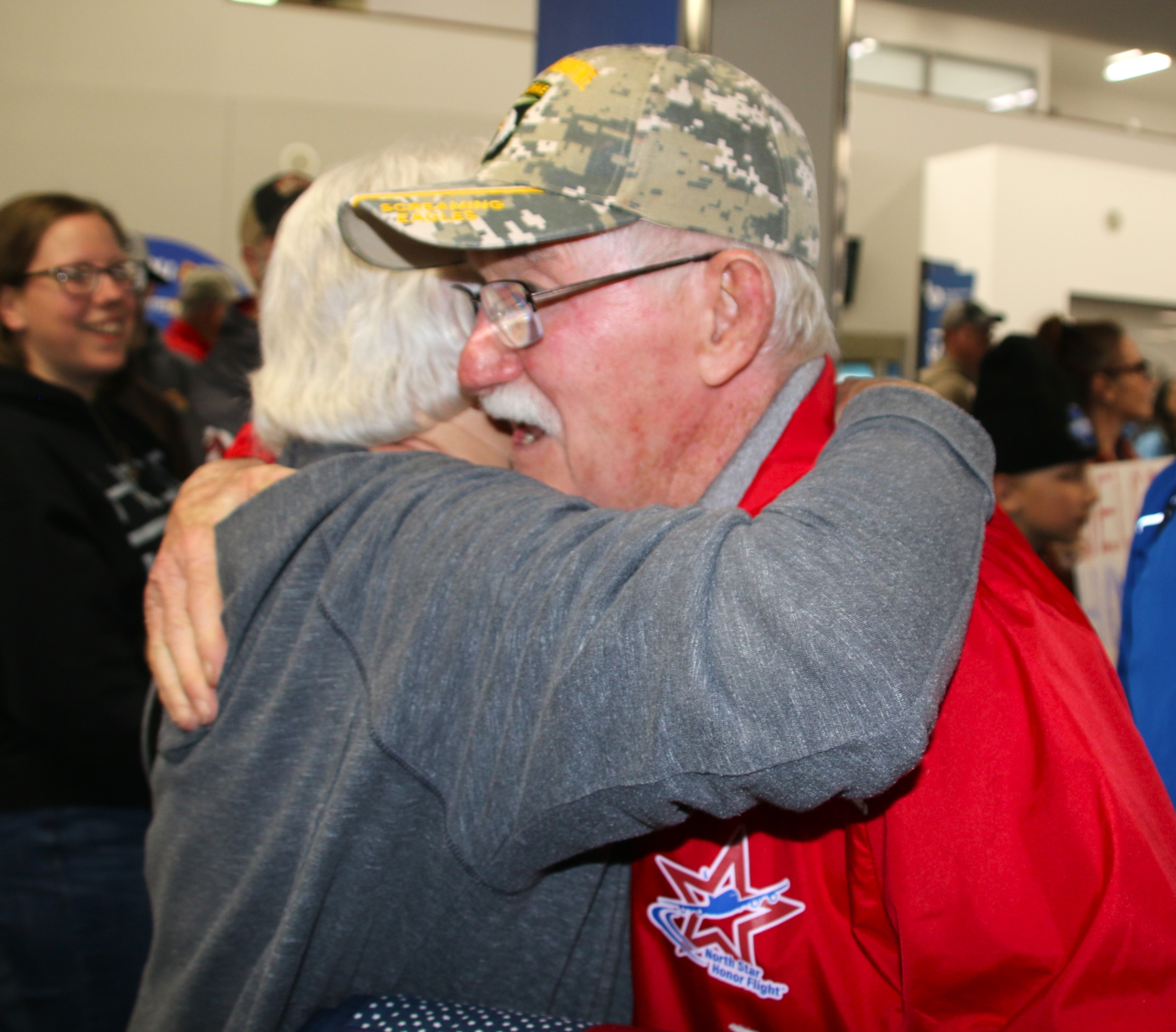
Cletus Glynn, of Blooming Prairie, receives a welcome-home hug after an Honor Flight to Washington, D.C., from Mary Sommers, of Ellendale, whose husband Wayne also made the trip. They were two of six veterans from Steele County to visit the nation’s capital. Staff photo by Kay Fate
-Wayne Sommers, Honor Flight Veteran
Wayne Sommers didn’t talk much about the year he spent in Vietnam, he admits, because old feelings linger long after the words are forgotten.
It’s one of the reasons the Honor Flight Network was formed: To celebrate America’s veterans by inviting them to share in a day of honor at the nation’s memorials, creating a nation “where all veterans experience the honor, gratitude and community of support they deserve.”
Sommers, of Ellendale, was one of six vets from Steele County aboard the North Star Honor Flight, based out of Adams, to make what has been called a life-changing trip.
Also on the flight were Jerry Ibberson and Dale Waage, both of Ellendale; Joe Falteysek, of Owatonna; and Cletus Glynn and Maynard Johnson, both of Blooming Prairie.
It was Mission 3, which for Sommers began at 3:30 a.m. April 27, when his daughter, Amber Bahe, picked up her father and her sister Lynn Eaton, who would accompany Sommers for the day as his guardian.
They were at Rochester International Airport by 5 a.m.; a short program honoring the veterans and guardians began at 5:10 a.m., followed by security screening before boarding a chartered flight to the east coast.
Once in D.C., the group was loaded on buses for a guided tour that included visits to many of the memorials: Marines, Korean War, World War II, Vietnam War, Navy Memorial, Lincoln Memorial, Dr. Martin Luther King Jr., FDR; the Air Force memorial; Arlington National Cemetery and the changing of the guard ceremony.
“He was pretty excited,” Bahe said that night. She was back at RIA, waiting with about a dozen family members for the plane’s expected 9:30 p.m. arrival.
“He wanted to see the Vietnam Memorial,” Bahe said of her dad. “He and my mom visited Washington, D.C., many, many years ago,” before the wall was built. “We had a cousin who fought over there and died in action. His name is on the wall, so he wanted to find that.”
Sommers knew about the Honor Flights, but it was Eaton who got the ball rolling.
“Our daughter had a coworker at Viracon whose dad went, so she was giving Lynn all the scoops on how to do the information,” said Mary Sommers, Wayne’s wife. They completed the application a little before Christmas.
And before he knew it, Sommers was walking down a jetway to patriotic music played by a band, with family members, friends – and strangers – cheering him the entire way.
It was a far cry from his arrival home from Vietnam in September 1966.
“He didn’t talk much about it right away,” Mary said. “The thing was – there was no welcome home. They had to take their uniforms off when they got off the plane and get into civilian clothes in the airport. That kind of hurt.”
It was more that they weren’t recognized – and it took a long time.
“He’s going to cry,” Bahe had predicted as they waited.
She was right; Sommers was emotional that night, and again about a week later, when he talked about the experience.
He was 22 when he arrived in Vietnam in September 1965, as U.S. forces were gearing up to engage.
“There wasn’t that much going on yet, as far as fighting, that we had heard of,” Sommers said. He would be part of the construction engineers; he was taught water purification techniques at Fort Leonard Wood, Mo., then helped load a troop train bound for Oakland, Calif.
There, they loaded everything on a troop ship – “including ourselves,” Sommers said – and spent the next 24 days at sea.
“When we got off the ship, it was like 120-some degrees,” he said. After a couple of nights in Cam Ranh Bay, his unit traveled south, along the Indian Ocean, to Phan Rang.
The construction engineers were tasked with building critical infrastructure “in the middle of nowhere,” Sommers said, to include runways and airfields. Army engineers developed bases, roads and ports to support the rapidly escalating troop presence.
“We purified water for everybody there – thousands of people,” he said, from a canal that carried water from the mountains. Upstream, the Vietnamese people would bathe and wash their clothes in it, “and the oxen would be in there.”
When monsoon season arrived, “it was really bad. It would be like this,” Sommers said, tapping a brown wooden table. Their work wouldn’t get it clear, “but we had medics that would come down two or three times a day and test the water.”
Like everyone else, his team worked around the clock: “We could never shut down,” he said. They slept in pup tents initially, then on cots in larger eight-person tents with mosquito netting.
“We were surrounded by Viet Cong,” but were never under attack, Sommers said.
His experience overseas was a positive one, as far as meeting the locals, “but the best part of my week was mail call – which was maybe once a week,” and included letters from his family and friends.
Sommers became emotional when discussing mail call – but it wasn’t memories from 60 years ago.
“I think it’s because of last week,” he said, when every vet on the Honor Flight received letters of support on the flight home.
He took several moments to compose himself as Mary Sommers pulled out a packet of correspondence.
In it were cards and letters from his children and grandchildren, as well as from students from schools in Iowa.
“Just think of all the ways you helped people … thank you for all you’ve done and all the effort that you put into it and all the people you helped serve,” one fifth-grader wrote. “I take all your sacrifices and all your hard work into my heart; I hope God has blessed you and all you’ve done.”
It felt a bit like Christmas, Sommers agreed, as one surprise after another was revealed.
Each veteran received a red Honor Flight jacket to wear for the trip; their guardians wore blue jackets. Every vet also received a hand-quilted lap robe.
Fred Asche, a veteran from Mantorville, gave everyone an ornament, hand-cut with a scroll saw, that said “I’m proud to be a vet.”
When Sommers left Vietnam nearly 60 years ago and landed at Fort Dix, N.J., not only were they not welcomed – they barely had transportation home.
“The airlines were all on strike,” he said, “so we couldn’t find a flight out.”
Finally, “we got what they called a flying boxcar; it held 10 or 12 of us,” when it landed in Kansas City, Mo. He took a “mail bus” to Owatonna, so named “because it stops at every little town.”
After a 30-day leave, he was back in the service until March 1967.
Bahe believes being with the Steele County Color Guard has helped her dad open up; they were there to greet the flight on April 27.
Sommers said he didn’t say much about his service when his children were growing up; “but now the kids and grandkids are asking me more and more all the time.”
But even in unpopular wars, he said, “I guess you do it for your country.”
In fact, Sommers believes “everybody should go into the service for maybe two years, and then you’re done; you grow up a little bit.”
He was able to get the rubbing of Dale Otto’s name, the cousin who was killed in action, as well as the name of his friend William Seykora, of Litomysl, who died overseas.
“I really wanted to see the Vietnam Wall, but the World War II one – that was fantastic,” Sommers said. “It is huge, and it is just beautiful. I enjoyed every moment.”
Still, he said, the trip wasn’t exactly closure, “but with everything they did for us,” compared to what they didn’t do in 1966, “now this really gives you a better feeling about what you did, I guess.”
And he wants others to feel better, too.
“I’ve been talking to different ones already, ‘if you get the chance, go,’” Sommers said of other veterans.
Mary Sommers, who didn’t know her husband until after his service, was also moved by the event.
“If they do it again, and we hear about it, I wouldn’t mind going to (Rochester) to welcome them back,” she said of the patriotic reception. “It’s really something to see.”