A frightful night at the Village of Yesteryear
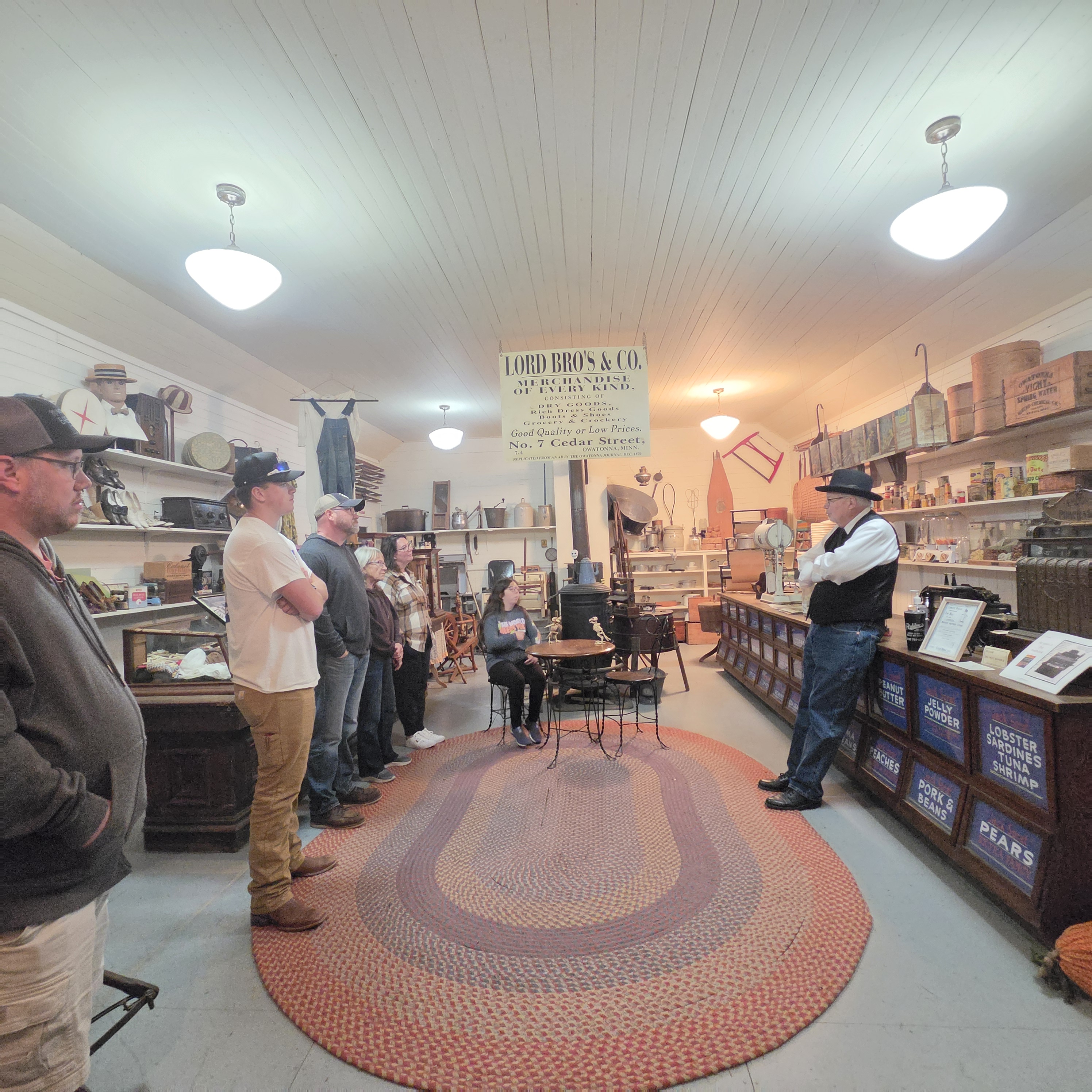
Ken Henrickson tells the visitors to the General Store about the strange events in the bar in downtown Owatonna. Staff photo by Karen M. Jorgensen
It was a scary and spooky night Saturday at the Steele County Historical Society’s Village of Yesteryear as the society opened the village for an evening of stories about strange happenings, ghostly images and murder at the Village Fright Night.
Visitors were invited to stop by the buildings in the village to hear a spooky or strange story. Some of the stories were directly connected to Steele County while others were more general in nature.
In the Dunnell House, visitors got to hear firsthand from Sarah Dunnell, who explained that her husband, Mark Dunnell, who had served as a U.S. congressman and state representative, had recently died but his presence was still felt in the house.
She explained she could hear him walking around the house and sometimes she could detect the smell of cigars which her husband smoked. He also liked to play pranks, she said, and sometimes she would find things turned upside down or pictures crooked on the walls. “He lives in the attic now,” she said.
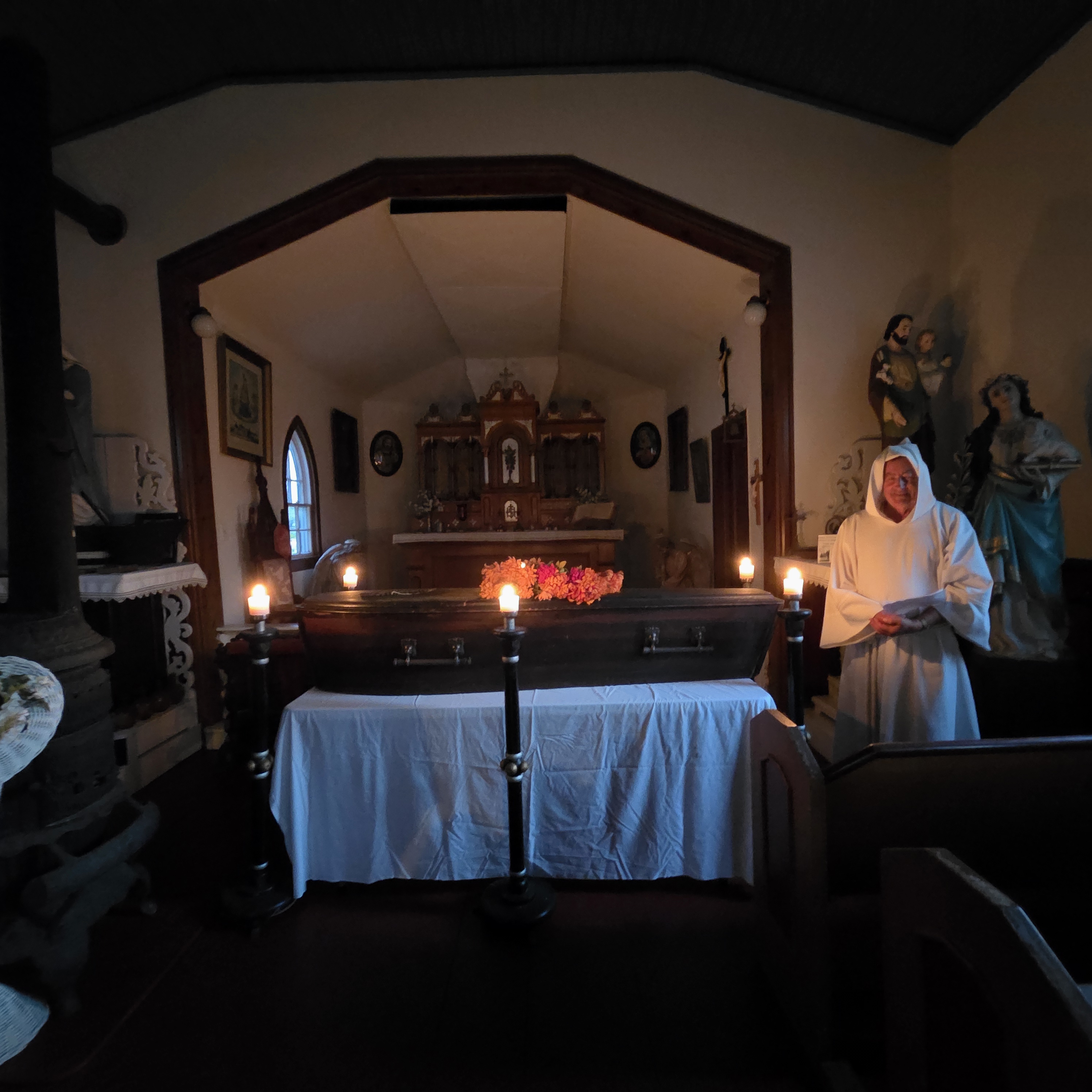
At the Saco Church, a priest was reading the eulogy for the deceased, an individual named Fred.
Poor Fred is dead, the priest intoned, while inviting people to gather around his coffin. Poor Fred, he said, tripped over a rope in the smokehouse. While many thought that Fred was a mean fellow, he really had a heart of gold of gold and loved everyone and everything.
Next door at the schoolhouse, Rose Henrickson was telling the story of two young women who were roommates at St. Olaf College.
Theresa and Amanda were sharing a room at the college in 1992. Theresa, she said, was the first to see a man wearing a red baseball cap in their room in the middle of the night. She screamed, but the man was gone. Amanda saw nothing. Theresa saw him again several times over the next few weeks.
Then Theresa went home for a long weekend, and Amanda was in the room alone. One morning, another girl came in and asked Amanda who the man in the red hat was she saw the night before, but Amanda said no one else had been in the room.
A week later, Henrickson said, Amanda also saw the man with the red cap in the room. Amanda and Theresa reported the sightings to the dean who said they should tell him not to come back and he did not.
The story, Henricksen said, may have been linked to a real tragedy. There was a cave nearby that had once been a brewery and a cheese factory, but it was closed off. One night five students had broken into the cave which collapsed and one of the boys had been killed. That student had lived in the same dorm room that Theresa and Amanda occupied and was known for liking to wear a red cap.
A local story, which was connected to actual events in Owatonna, was explained to visitors who stopped by the General Store by Ken Henricksen.
At the end of the Civil War, he said, a couple, Mr. and Mrs. Elisha Hunewill, moved to Owatonna and opened a hardware store. The building, in downtown Owatonna, had earlier been a brewery.
The hardware store thrived but when Elisha died his wife, Elizabeth, did not want to continue to run the business and sold the building to a man who said he was going to open a bar at the location.
Once the bar was opened patrons reported seeing supernatural occurrences. One morning, when the owner opened the bar, he found bar stools overturned. He called the night bartender who told the owner that when he closed the bar for the night everything was in order. The building, currently empty, most recently housed the Foremost Brewery.
As for Elizabeth Hunewell, when she died, she set aside money in her will stating that if the city built a public library, the funds were to be used to finish the building and purchase books. The city voted to approve public funds in 1898 and 1899, and the library opened in 1900.
A darker true story was told by Noah Moore over in the depot.
In September 1897, two businessmen, Lee Howe and Joseph Clark, were traveling through Owatonna in their covered wagon. They stopped at the hotel but slept in their wagon overnight. During the night, Howe bludgeoned Clark and stole cash and a watch. He then fled south out of town on the train.
The next morning, at about 10 a.m., the proprietor of the hotel came out to check on the two men. He found Clark who was still alive but did not survive his wounds.
The sheriff and a deputy followed the leads and caught up with Howe in Guthrie, Kentucky. He was returned to Minnesota, pled guilty and sentenced to life in prison. He spent 14 years in Stillwater where he was described as a model prisoner.
In 1912 he appealed his sentence saying he was only 19 years old at the time of the murder. His appeal was initially denied but in 1918 his sentence was reduced to 30 years and he was released. Upon his release he signed up for the World War I draft but was never called. He moved to California and died there is 1960.