


Local amateur radio operators take part in national field day
-Mike Conrad, Amateur Radio Enthusiast
The grounds at McKinley Elementary School in Owatonna were a busy place over the weekend with cars, trailers and radio antennas filling the space.
The 24-hour event, which began Saturday at 1 p.m. and was scheduled to continue until 1 p.m. on Sunday, was a field day for amateur radio, primarily ham radio, operators from the Owatonna Club who were participating in a field day that included radio enthusiasts from throughout the United States, Puerto Rico and Canada.
Most of those participating are involved with one or more volunteer emergency services programs in Steele County, including Community Emergency Response Team (CERT), Skywarn, the severe weather spotter program, Radio Amateur Civil Emergency Service (RACES) and Community Awareness Emergency Response (CAER).
The volunteers in these programs respond to disasters including tornadoes and floods, when requested by the county Emergency Management Agency.
All the radio operators are licensed by the FCC after completing training and passing license tests. The levels of operators range from novices to technicians, to general to extra. While there are restrictions on which frequencies are permitted to those at the various levels, those who reach the extra level can operated to all U.S. amateur radio bands.
Most of those participating in amateur radio operate their equipment from their homes but once a year they get together for the field day where the goal is to contact as many other operators as possible over the 24-hour period.
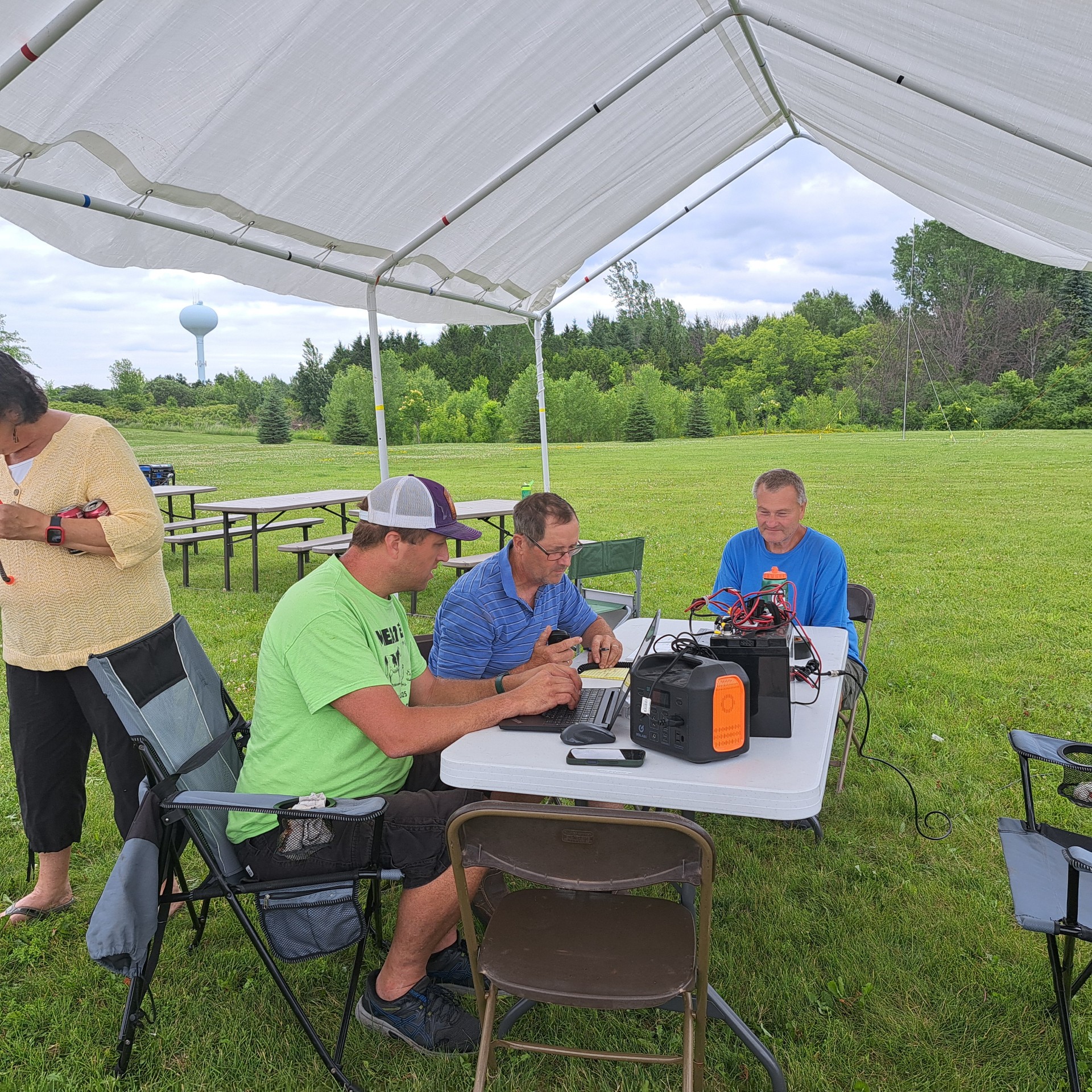
In addition to the individual operators who brought their equipment to the school, a radio was set up on what was named the Get On The Air (GOTA) site to give anyone visiting, including those who were not licensed or had little or no experience with ham radio, to give it a try.
First task of the day was to set up the equipment which in addition to the radio itself included the antennas to send and receive the signals.
With the antennas set up and the radios up and running it was time to start communicating with their fellow ham operators throughout North America.
Tim and Bonnie Johnson had their equipment set up in their motor home. Bonnie said she had gotten involved in amateur radio when she was the president of CERT, attended classes and took and passed the FCC tests. Tim got involved, she said, after the two were married.
Dale Carlson said he has been interested in radio for a long time. He said he has been involved for 51 years, since he was introduced to it as a 14-year-old by his cousin who had a “great big radio in his VW bug with a big antenna.” He first got involved with radio in northwest Minnesota and said when he contacted a guy in South Dakota he was hooked.
Several of those attending were newcomers, including Dennie Huisenga and Mark Driessen who just passed their license test in March and were over in the GOTA tent getting some more experience. By early Saturday evening, they had logged 35 contacts.
While most operators were making their contacts by radio, some individuals use an older form of communication. Matt Arthur was in one of the trailers intently making contacts using Morse Code.
Huisenga’s son, Kyle, who has been involved with amateur radio for about two-and-half years, was the one who first got his father interested. Amateur radio, he said, is an activity where one is never too young or never too old to get involved.
While most participants are communicating with radio and logging the information about their contacts on their computers, some amateur radio fans still use older methods, including Matt Arthur, who was in one of the trailers intently focused on communicating by Morse code.
The field day, participants said, is a great way to communicate with those in other parts of the country and practice the skills they will need to use in case of a local emergency.
The importance of amateur radio operators during an emergency was on the minds of a number of last weekend’s participants.
They said they had been asked to refrain from using certain bands because they had been set aside for emergency assistance to the people in Venezuela because of last week’s earthquakes.
That’s one of the important things they do, said participant Mike Conrad.
“We want to help the community,” he said. “Probably some ham operators will go to Venezuela.”
In a situation such as an earthquake or hurricane where all other forms of communication are unavailable, it is the amateur ham radio operators who take up the slack by communicating messages between those in the affected areas and people in the rest of the country.
Early in the evening, the Owatonna group was visited by Bill Mitchell, the section manager for Minnesota.
Mitchell, who lives in the metro area, said he was trying to reach as many groups participating in the field day as possible, this year concentrating on Saturday concentrating on southern Minnesota. He was making the rounds, he said, for the National Association of Amateur Radio Association.
He said that there were about 1,460 sites operating nationally for the event that had invited the public to stop by and visit to learn more about amateur radio.
While most of those participating, he said, were making contact through voice and using antennas, some were bouncing off satellites.
While a few of the participants in Owatonna would try to contact others for as many of the 24 hours as possible, including Arthur and his Morse code, most would take a break at some point overnight.
They would keep going, Carlson said, unless lightning was detected at which time they would shut down to avoid damage to the radios.