


‘Promoting Peace’ event focuses on answers
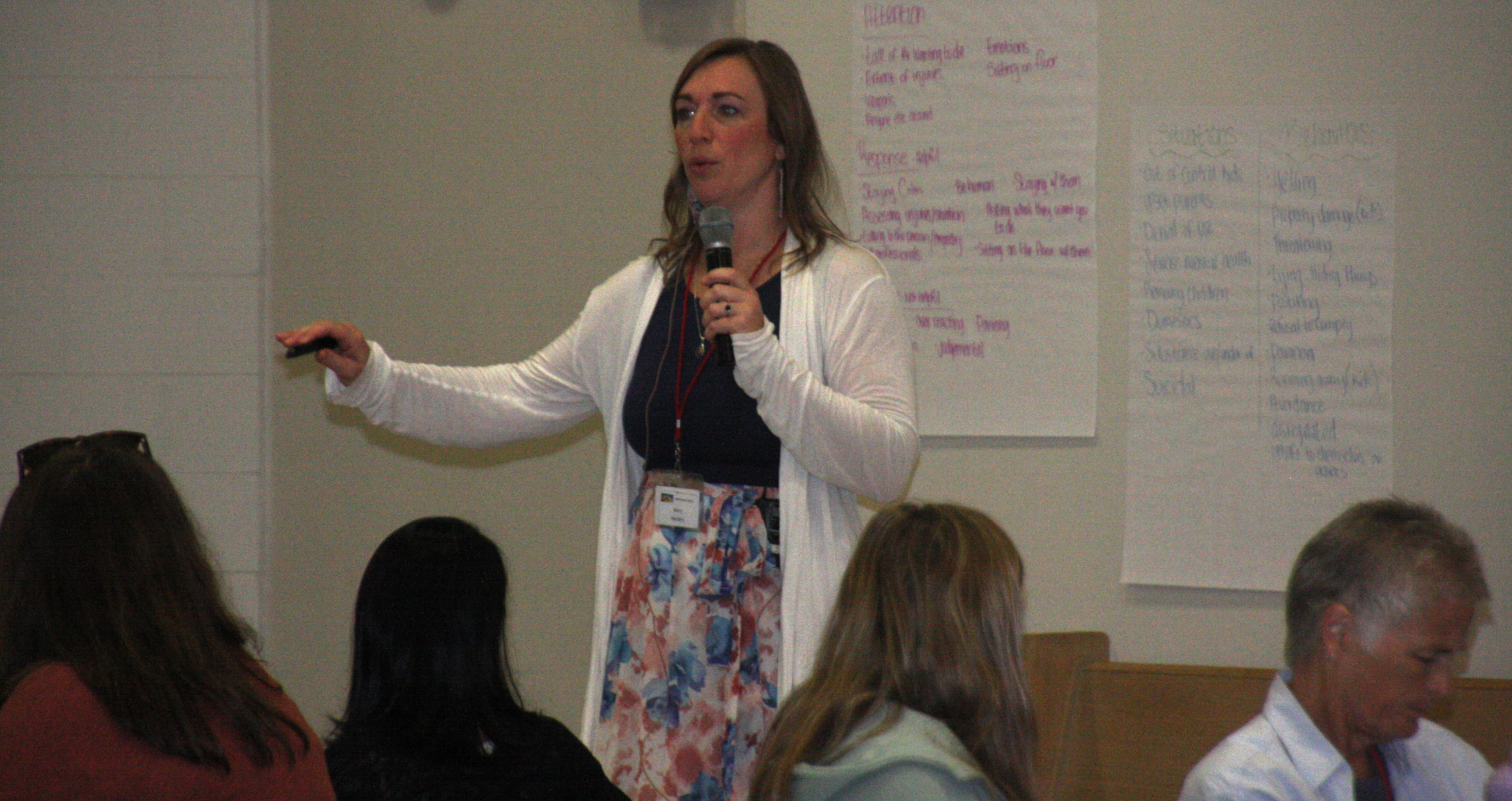
Mary Harders, the mobile response program manager at Spero, facilitated a presentation and interactive experience to practice de-escalation techniques during the 2025 Promoting Peace Conference. Staff photo by Kay Fate
Do you remember the last time you were really, really angry? Frustrated? Frightened?
What helped calm you? Chances are, it wasn’t someone telling you to “calm down.”
There are plenty of other methods that actually work, said Mary Harders, then provided several examples.
The mobile response program manager at Spero, Harders offered lessons and tools to navigate de-escalation through a series of interactive scenarios.
It was one of four issues addressed during the 2025 Promoting Peace Conference held last week in Owatonna.
Since its inception in 2015, the annual gathering often features a theme, “a reflection on what’s happening, what’s top of mind for community members,” said Karen Duncan, a judge in the Third Judicial District, which includes Steele County.
“We focused one year on youth and children and their mental health,” she said, “so maybe there’s a little repetition this year, but people really are worried about our kids.”
Attendees include social workers; people who work in the justice system – including attorneys and probation staff; members of law enforcement; health care providers; educators; “some folks in therapeutic work in advocacy,” Duncan said, “and community members – the helpers in the community.”
The conference is designed to build better understanding and communication between all interested parties, she said. “Sometimes the most important things that happen today will happen over lunch, or out in the parking lot afterward.”
In addition to the de-escalation tactics, participants were guided through dialectical behavior therapy, myths on masculinity and restorative justice.
Harders told the group that effective listening follows a 7/38/55 Rule:
Seven percent of communication is spoken; 38% of communication is the tone, rate and volume of our voice; and 55% of communication is body language, including facial expressions, posture, movements, stance and presence.
As valuable as knowing what responses are helpful is knowing what responses are not helpful, Harders said.
“It’s really about coming alongside somebody,” she said. “Instead of saying, ‘at least it’s not…’ or ‘it could be worse…,’ try saying, ‘that must be really difficult.’ Sometimes comparisons are helpful to people, but when someone’s in a crisis situation, the last thing they need you to do is minimize what they’re going through.”
Harders facilitated role-playing and de-escalation scenarios, allowing the participants to develop their own skills.
“We really want people to gain something that they can use in their daily lives,” Duncan said, whether that’s at work, home or out in the community.
The people in Steele County, she said, “just want to do the right thing, and the more we know, the more effective we can be. This is such a powerful community.
“When we come together like this, then it’s not passing the responsibility to others,” Duncan said. “We can say, I’m not a therapist, but it’s OK for me to do these things” to help in situations that may arise around us.
Among the professionals in the room sat Leah Sherman.
Now a senior at Owatonna High School, “I started as a junior in a new town in a big high school, and it was rough,” she said. “I have the whole alphabet in my head, you know?”
Sherman was talking about her PTSD, anxiety and ADHD.
“Because of that, and because of my struggle in the subjects in school, and the social (interactions) on top of that, I had to remove the social (aspect) to be able to do any of the subjects,” she said.
That led to years of home schooling; she is now nearly a 4.0 student at OHS.
“I think it’s important to see this type of thing because as a student, I see a lot of my peers and their behaviors that are kind of like that, you know?” Sherman said of the de-escalation tactics Harders demonstrated.
“I think a lot of teenagers struggle with their mental health, to different levels,” she said, “so it’s interesting to look at the perspective from social workers and lawyers and people who see it in the court system when it gets a little out of hand.
“If there’s a fight at school, I know my mom is going to be dealing with that later that day.”
Her mother is Esther Sherman, Assistant Steele County Attorney, who handles juvenile cases.
“Into my teens, I’ve come to Promoting Peace with my mom to help her feel supported,” Leah Sherman said.
As a home-schooled student, “my ‘civics class’ was when I would sit in on trials and volunteer at Promoting Peace, passing the microphones to speakers, but I actually got involved in the activity today,” she said.
With the help of Margo McKay, her counselor at OHS, “I’ve come a long way,” Sherman said.
She appreciates the outside perspectives from people who have struggled with emotions and mental health, as well as those who have helped them.
“I find it helpful not just when it comes to handling other people,” she said, “but I can also use this on myself. Am I overreacting? Do I need to take a breath? Do I need to sit down to get that adrenaline level to go down a little bit?
“Do I need a hug?” Sherman continued. “(Harders) talked about what percentage was body language, and that’s very, very important.”
She has mediated disputes among friends, as well as with siblings, but has a different career path planned.
Still, she said, “I find it useful in everyday life. It’s very helpful to have the skills to say, ‘Let’s sit down and talk about it. Are you hurt, or are you angry? Or are you both?’ I’m really interested in it.”