


TOUGH CROWD
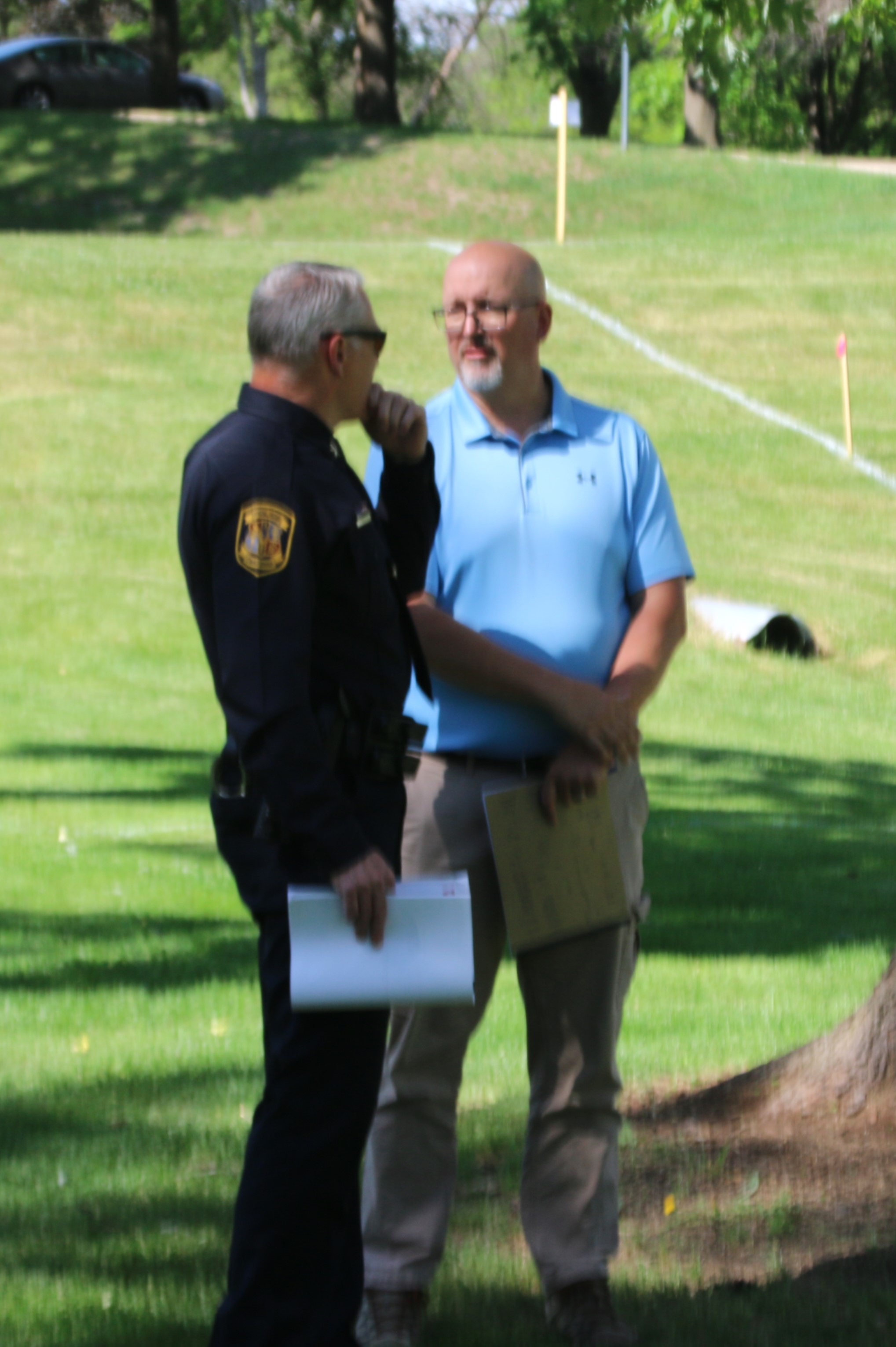
-Chad Lange, Retired Businessman
A site tour of the proposed location of a new police station on the West Hills campus of Owatonna got off to a rocky start – and didn’t improve much as it progressed.
The tour was planned for 4 p.m. May 2; people who went to city council chambers were told to walk over to the proposed site, which is near the West Hills Social Commons, formerly known as the Senior Center.
About 40 people milled around there, some with protest signs, others with cameras at the ready, when Capt. Josh Sorensen of the Owatonna Police Department approached.
“You’re supposed to head over to the council chambers,” he said, drawing immediate – and heated – reaction.
While some pointed out the conflicting directions, others were angry about the lack of accessibility.
“I have a legitimate question,” said Melissa Zimmerman, who has been a leader of the push to reimagine the proposal. “We have people that cannot literally walk.”
Indeed, there were a few people on mobility scooters, some with walkers, others with canes. The site is on a hilly, grassy area with no sidewalks.
“Let’s just do it here,” several people shouted at Sorensen, who asked the crowd to listen to him.
“If you guys don’t want to be part of the whole presentation, just wait here,” he said, adding that he had just arrived.
“That’s the point,” another woman said. “It needed to be communicated before we got here.”
“Why would they listen to us now?” Lynne Holthus asked. “They don’t listen to us any other time.” She, too, is opposed to the proposed site, which is where children of the former state school lived in cottages that have since been destroyed.
The campus was home to the State Public School for Dependent and Neglected Children, where about 11,000 children lived from 1886 to 1946. It was a precursor to what became the current child welfare system.
Holthus’s father lived at the orphanage.
Zimmerman told Sorensen that because the event was described as an open meeting, “it should be open and accessible to everyone… He struggled to get here, because there’s a curb all the way around” the site, she said, pointing to a man with a walker. “It required additional help. Is the city prepared to help me with those who cannot walk?”
“Well, I sure will,” Sorensen said.
He told the crowd that city officials wanted people at the council chambers to “explain the whole area here” and how the project is designed.
“Well, it’s a dog and pony show,” said Chad Lange, an Owatonna native, longtime businessman and developer, and former member of the Owatonna City Council.
“We’re starting where they want to start,” he said. “What we’re doing today is looking at where it will not be built, that’s all we’re doing.”
The tour was led by Chris Ziemer, of ICS, the construction manager for the proposed public safety facilities in Owatonna.
It started at the intersection of State Avenue and Dunnell Drive, which winds up the hill into the campus.
The proposed new police facility would include a realignment of Dunnell Drive for more direct access to the building and a squared-off intersection with West Hills Circle.
The new road design and the footprint of the building were marked with white lines and stakes. Planned parking lots were not staked off.
As the tour reached the spot where the original group of people waited at the top of what is called the sledding hill, someone asked Ziemer if he had a permit for the microphone and speaker he was using.
“Permits are needed. Do you have a permit, because you’re supposed to have one,” the woman said.
“Go ahead and turn it off, Chris,” said City Administrator Jenna Tuma.
Within moments, people were complaining of being unable to hear Ziemer.
As the tour continued to wend its way around the west side of the property, which will have an employee parking lot, Zimmerman asked where the final property line would be.
“That’s over here,” Ziemer said, waving toward the homes on Glendale Street that abut the property.
“Can you specify that any better than ‘over here’?” a woman asked.
It was not surveyed for the tour, Ziemer said, so there were no stakes.
The woman asked how they were supposed to have a “proper image of the whole situation.”
“The idea was to give a proper representation of the building,” the consultant said, “what the building limits are.”
“But we’d like to see where everything is going,” was the reply.
More questions arose when Zeimer spoke about changes to the property, including where the existing drainage pond will be relocated.
“How much closer to my house are you moving that?” asked a woman who lives on Glendale Street.
“We can provide that information; I don’t have that exactly measured out right now,” Ziemer said.
“I hope you do, because you just keep giving me the runaround when I’ve asked for it many times,” the resident said. “I mean seriously, it’s getting ridiculous.”
“We’re still in design right now,” Ziemer said, “so nothing’s completely set. Not everything has an answer until we’re done with the documents.”